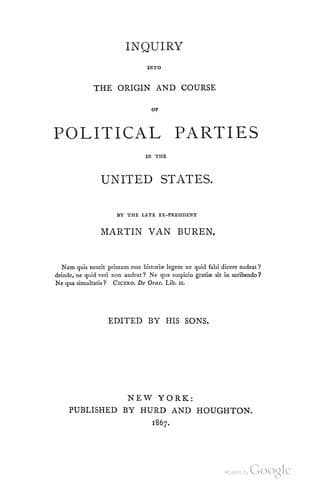
Inquiry Into the Origin and Course of Political Parties in the United StatesVan Buren, Martin
History
Inquiry Into the Origin and Course of Political Parties in the United States
Van Buren, Martin
Political parties -- United States
A pretense was set up by the relator's counsel that the court might
claim the desired authority under that part of the Judiciary Act
providing necessary means to enforce its appellate jurisdiction, which,
after specifying the cases in which such jurisdiction may be exercised,
and pointing out the way in which it may be carried into effect, adds to
the authority to issue writs of prohibition to the district courts in
certain cases--"and writs of mandamus, in cases warranted by the
principles and usages of law, to any courts appointed or persons holding
office under the authority of the United States." Now the plain
intention of this clause of the sentence was to extend the right of
issuing a mandamus, in the exercise of its _appellate jurisdiction_, to
any subordinate authorities upon whom Congress might confer judicial
power, whether that power was given to a court, or to a single officer
not constituting a court according to the ordinary interpretation of
that word. The commissioners subsequently appointed under the Fugitive
Slave Act are officers of that description. To think otherwise is to
suppose that the men who framed the Judiciary Act of 1789 designed by
the terms they employed to give to the Supreme Court original
jurisdiction in cases in which it was denied to it by the
Constitution--a design too absurd and too disingenuous to have found
even a momentary resting-place in the minds of those great men. The
court so far countenanced this interpretation as to assume, for the sake
of the argument, that the words "or persons holding office," might
embrace the case before it. But it immediately proceeded to disprove the
assumption by saying, "It has been stated at the bar that the appellate
jurisdiction may be exercised in a variety of forms, and that if it be
the will of the legislature that a _mandamus_ should be issued for that
purpose that will must be obeyed. _This is true_; yet the jurisdiction
must be _appellate_ not _original_,"--and the court goes on to show that
this proceeding would in no sense be regarded as an exercise of
appellate jurisdiction; adding to that demonstrative refutation the
declaration, that if the act would bear the interpretation given to it
by the counsel, it would be directly contrary to the Constitution and
therefore void. That the court had not the slightest right to do what it
was asked to do, or to take original jurisdiction of the matter in any
form, was a point upon which it expressed no doubt; and if it had
decided the questions in the order in which they were presented by the
relator's counsel, the necessity of dismissing the motion before coming
to the consideration of the merits of the case would have been too
imperative to be overcome.
Public-domain text, read in full here on John Shaqi.
Reviews
Reviews
No reviews yet
Be the first to share your thoughts on this work.
Elsewhere in the archive
Join the Discussion
Join the discussion
Sign in to leave a comment or review.
Sign InorCreate an account