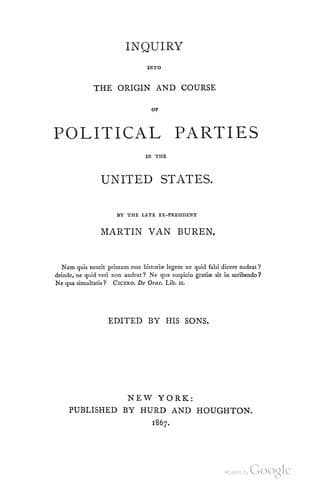
Inquiry Into the Origin and Course of Political Parties in the United StatesVan Buren, Martin
History
Inquiry Into the Origin and Course of Political Parties in the United States
Van Buren, Martin
Political parties -- United States
I apply the remark to them individually, because Chief Justice Marshall
was the principal, and seemingly the sole actor, in the proceedings on
the part of the court, and because the retention of the commissions--the
grievance those proceedings were designed to redress--was not merely an
executive act, but one committed in pursuance of the specific direction
of President Jefferson. This was always avowed by the latter, and the
guarded manner in which the replies of Mr. Madison are stated in the
report of the case is, to my mind at least, sufficient proof that the
President was throughout considered and treated by the Chief Justice as
the actual offender in the matter.
In respect to the soundness of the volunteer opinion of the court it
would be superfluous, considering the fate that awaited it, to do more
than to restate the question. This may certainly be done with more
brevity and perhaps with equal distinctness.
It will not be denied that President Jefferson had the same power over
the subject on the 4th March that Mr. Adams would have possessed if his
term of office had not expired on the 3d. The President under our
system, like the king in a monarchy, never dies. Let us then suppose
that Mr. Adams, after he had signed the commission and caused the seal
to be affixed to it, but before it had been recorded or delivered, had
discovered that the appointee was a felon, or for any reason an
obviously improper person to be made a conservator of the public peace,
was he not authorized to withhold it? The appointment is made by the
Constitution to consist of three acts--the nomination, the approval by
the Senate, and the commissioning. The first and last devolve on the
President. The signatures to them must necessarily be his own act; but
Congress supplies him with a Secretary of State subject to his own
directions, to do whatever else is necessary, viz.: to affix the seal to
the commission; to record it; and to cause it to be delivered or
transmitted to the appointee. The President is apprised of the
impropriety of the appointment,--an act which the Constitution had
devolved on him alone,--the commission is yet in his possession, for the
office of Secretary of State is, for all such purposes, his office, and
the question would not have been changed if the seal had been affixed at
the President's House; can it be for a moment supposed that the
Constitution intended that his power over the commission ceased the
moment he attached his signature, or the Secretary the public seal, and
that after that he had no right to arrest further proceedings, however
strong his reasons for so doing? Can it be presumed that its framers
intended to invest the President in the discharge of his responsible
duty to "commission all the officers of the United States" with an
authority so precise and technical? It is on all sides conceded that he
is not bound to commission after the Senate has approved, but has still
Public-domain text, read in full here on John Shaqi.
Reviews
Reviews
No reviews yet
Be the first to share your thoughts on this work.
Elsewhere in the archive
Join the Discussion
Join the discussion
Sign in to leave a comment or review.
Sign InorCreate an account