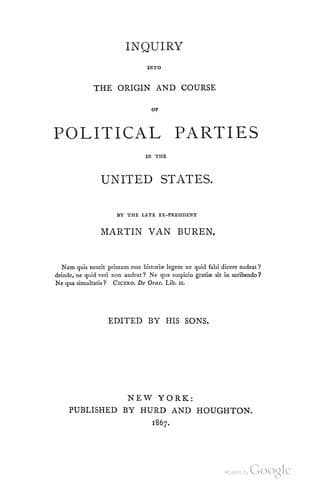
Inquiry Into the Origin and Course of Political Parties in the United StatesVan Buren, Martin
History
Inquiry Into the Origin and Course of Political Parties in the United States
Van Buren, Martin
Political parties -- United States
But in the midst of these declarations are found these unguarded words:
"Each public officer who takes an oath to support the Constitution,
swears that he will support it as he understands it and not as it is
understood by others." Either this declaration was applied by the
President only to all _such_ officers as those of whom he had been
speaking before and of whom alone he spoke afterwards, all in the same
paragraph,--to that class of officers who, singly as was his own case,
or in conjunction with others as was the case with some, constituted the
three great departments of the Government, whilst acting in their
respective official capacities, as it was beyond all doubt intended to
be applied; or he must be supposed to have held that the inferior judges
of the federal courts had a right to say to the superior court, "We do
not understand the Constitution as you have expounded it, and we will
therefore not submit to your decision;" the same as to the judges of the
State courts of every grade, and as to the officers of the custom-house
and innumerable other officers of his own appointment; empowering the
latter on the same ground to refuse to conform to the instructions sent
to them, &c., &c. A construction, one would think, too preposterous for
credulity itself to swallow.
The plain and well-understood substance of what he said was that in
giving or withholding his assent to the bill for the re-charter of the
bank it was his right and duty to decide the question of its
constitutionality for himself, uninfluenced by any opinion or judgment
which the Supreme Court had pronounced upon that point, farther than his
judgment was satisfied by the reason which it had given for its
decision. This covered the whole ground. It explained fully his views of
the Constitution in respect to what he was doing. All beyond was both
uncalled for and unnecessary. To this view of the President's power and
duty under the Constitution Mr. Webster assented in the fullest manner.
He said,--"It is true that each branch of the legislature has an
undoubted right, in the exercise of its functions, to consider the
constitutionality of a law proposed to be passed. This is naturally a
part of its duty, and neither branch can be compelled to pass any law,
or do any other act, which it deems to be beyond the reach of its
constitutional power. The President has the same right when a bill is
presented for his approval; for he is doubtless bound to consider, in
all cases, whether such bill be compatible with the Constitution, and
whether he can approve it consistently with his oath of office."
Public-domain text, read in full here on John Shaqi.
Reviews
Reviews
No reviews yet
Be the first to share your thoughts on this work.
Elsewhere in the archive
Join the Discussion
Join the discussion
Sign in to leave a comment or review.
Sign InorCreate an account