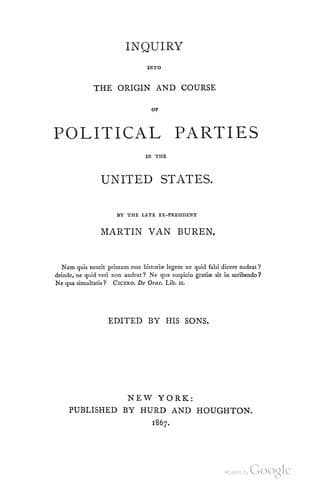
Inquiry Into the Origin and Course of Political Parties in the United StatesVan Buren, Martin
History
Inquiry Into the Origin and Course of Political Parties in the United States
Van Buren, Martin
Political parties -- United States
unconstitutional, which had been approved by one of his predecessors,
but which he, notwithstanding, conscientiously believed to be
unconstitutional, and for withholding the power of the executive from
the execution of any such act. Everybody knows that an act which is
contrary to the Constitution is a nullity, although it may have passed
according to the forms of the Constitution. That instrument creates
several departments, whose duty it may become to act upon such a bill,
in the performance of their respective functions. The theory of the
Constitution is that these departments are coördinate and independent of
each other, and that when they act in their appropriate spheres they
each have a right, and it is the duty of each to judge for themselves in
respect to the authority and requirements of the Constitution, without
being controlled or interfered with by their co-departments, and are
each responsible to the people alone who made them for the manner in
which they discharge their respective duties in that regard. It is not
therefore to be presumed that that instrument, after making it the
President's especial duty to take an oath to preserve and uphold the
Constitution and prevent its violation, intended to deny to him the
right to withhold his assent from a measure which he might
conscientiously believe would have that effect, and to impose upon him
the necessity of outraging his conscience, by making himself a party to
such a violation. The Constitution, which was framed by great men, the
form of which has been so much and so justly admired, is not so
imperfect nor subject to such a reproach. The matter does not
necessarily end with a refusal on the part of the executive to do an act
which he believes Congress had no right, under the Constitution, to
require his department to perform. Although the President, representing
one of the three great departments of the Government, possesses in this
respect a right which neither the citizen nor any other officer or
officers of the Government, not having the control of such a department,
can exercise, yet if he allows himself to be governed by unworthy
motives he is liable to impeachment and expulsion from office. It is in
this way, or by his removal by the people, that the wrong he does to the
public is redressed. But this is not all. If the act has been passed
according to the forms of the Constitution, and is judged to be
constitutional by the judicial department of the Federal Government, it
is obligatory upon the citizens, binds and controls their private rights
and personal interests, and can be carried into effect in respect to
those by the judiciary, which also judges for itself regarding the
constitutionality of such law. It is the department by which laws,
affecting as well the private rights of the citizen as those of the
States, which can be made the subjects of litigation, are carried into
effect. It has ample power conferred upon it to cause its judgments and
decrees to be executed.
Public-domain text, read in full here on John Shaqi.
Reviews
Reviews
No reviews yet
Be the first to share your thoughts on this work.
Elsewhere in the archive
Join the Discussion
Join the discussion
Sign in to leave a comment or review.
Sign InorCreate an account