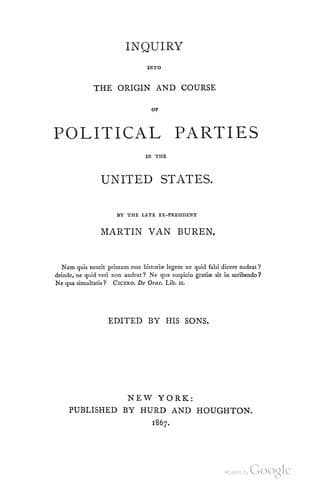
Inquiry Into the Origin and Course of Political Parties in the United StatesVan Buren, Martin
History
Inquiry Into the Origin and Course of Political Parties in the United States
Van Buren, Martin
Political parties -- United States
Nor have the people been slow to exert their powers to reform abuses
which they honestly, whether erroneously or not, believed to exist, by
displacing representatives whom they considered unfaithful, whenever the
occasion has seemed to them of sufficient magnitude to call for its
exercise. The commencement of the nineteenth century was made forever
memorable in our political annals by a display of this power, and it was
again exerted in 1828, in 1840, in 1844, and in 1852. The result of the
election of 1848 was altogether occasioned by divisions in the
Democratic party, and I feel that I venture nothing in attributing that
of 1840 mainly to a mistake in the public mind, which it has since
magnanimously acknowledged, and with that atonement I am more than
satisfied.
But if the incumbents of the legislative and executive departments have
no right to decide for themselves constitutional questions that arise in
the performance of their official functions; if it be indeed true that
the National Legislature, in discharging the important duties of laying
and collecting taxes, duties, imposts, and excises; in borrowing money
on the credit of the United States; in regulating commerce with foreign
nations, and among the several States, and with the Indian tribes; in
establishing uniform rules of naturalization and on the subject of
bankruptcies; in coining money and regulating the value thereof, and of
foreign coins, and fixing the standard of weights and measures; in
providing punishment for counterfeiting the securities and current coin
of the United States; in establishing post-offices and post-roads; in
promoting science and useful arts; in constituting tribunals inferior to
the Supreme Court; in defining and punishing piracies and felonies
committed on the high seas and offences against the law of nations; in
declaring war; granting letters of marque and reprisal, and making rules
concerning captures on land and water; in raising and supporting armies;
in providing and maintaining a navy; in making rules for the government
and regulation of the land and naval forces; in providing for calling
forth the militia to execute the laws of the Union, suppress
insurrection and repel invasion; in providing for organizing armies and
disciplining the militia, and for governing such parts of them as may be
employed in the service of the United States; in the exercise of
exclusive jurisdiction in all cases whatsoever in the ten-mile-square
and in the forts of the United States; and in making necessary and
proper laws for carrying into execution the foregoing powers and all
other powers vested by the Constitution in the Government of the United
States, or in _any department_ or officer thereof: and that the
President, in assuming command of the army or navy of the United States
and of the militia of the several States, when called into their
service; in making treaties by and with the advice of the Senate; and in
Public-domain text, read in full here on John Shaqi.
Reviews
Reviews
No reviews yet
Be the first to share your thoughts on this work.
Elsewhere in the archive
Join the Discussion
Join the discussion
Sign in to leave a comment or review.
Sign InorCreate an account