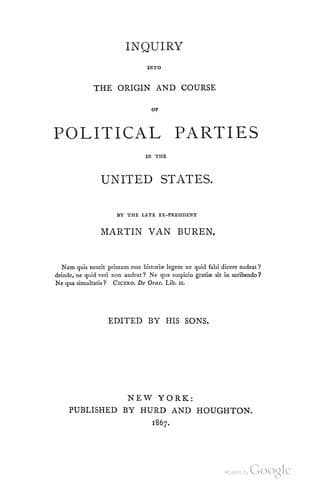
Inquiry Into the Origin and Course of Political Parties in the United StatesVan Buren, Martin
History
Inquiry Into the Origin and Course of Political Parties in the United States
Van Buren, Martin
Political parties -- United States
If this essay shall be ever published, the censures I have bestowed upon
the old Federal party and its successors for their persevering efforts
to destroy the balances of the Constitution, in this respect of the
relative powers of the departments, will doubtless be met by those who
still sympathize with its opinions, by a reference to the proceedings in
the case of Dred Scott. Of this no one will have a right to complain, so
long as those who so refer confine themselves to facts; for truth is
truth, whatever may be the circumstances under which it is applied, and
wrong is wrong, by whomsoever it may be committed and by whatever party
it may be sustained. It will be alleged that the Supreme Court, now
composed of gentlemen who are acknowledged members of the Democratic
party, has in that case set up the right to guide the official action
of the executive and legislative departments of the Government upon a
great constitutional question,--that the Executive has recognized that
right, and has promised to conform his own course to it when exercised,
and that these proceedings have received the approbation and support of
the Democratic party.
In the notice I propose to take of that case, it is not my intention to
discuss the correctness or incorrectness of the decision that was made
in respect to the power of Congress to legislate upon the subject of
slavery in the Territories. I will however state in advance and in few
words the view I now take of the general subject.
The acquiescence of the country in the power of Congress referred to,
from the Presidency of Washington to that of Polk inclusive, is well
known. Every President signed bills for carrying it into effect, when
any such became necessary and were presented for their approval, and the
other great departments of the Government not only complied with the
rule but, in innumerable instances, recognized its validity. This
continued until the year 1848, when a point, which had so long been
considered settled, was brought in question by an opinion expressed by
General Cass, then being a candidate for the Presidency, in a letter to
Mr. Nicholson, of Tennessee, adverse to the powers of Congress. The
Democratic party, whose candidate he was, adopted his opinions, and the
consequences were a rupture in that party, the elevation of an
old-school Federalist to the Presidency, and an administration of the
Federal Government upon the long exploded principles of Federalism. In
1852 the Democracy of the Union, instructed by experience in regard to
the destructive tendency of slavery agitations, resolved to avoid them
in future, united on General Pierce as their candidate, supported him
on their old and time-honored principles, and elected him by a
triumphant majority.
Public-domain text, read in full here on John Shaqi.
Reviews
Reviews
No reviews yet
Be the first to share your thoughts on this work.
Elsewhere in the archive
Join the Discussion
Join the discussion
Sign in to leave a comment or review.
Sign InorCreate an account