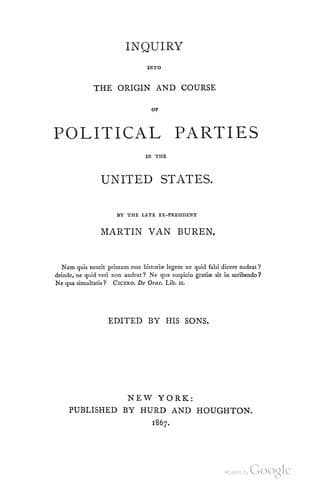
Inquiry Into the Origin and Course of Political Parties in the United StatesVan Buren, Martin
History
Inquiry Into the Origin and Course of Political Parties in the United States
Van Buren, Martin
Political parties -- United States
In the Federal Convention which framed our present Constitution General
Hamilton submitted a series of propositions to be adopted as a basis for
the new government, which he supported in an elaborate and very able
speech. The debates of the Convention were reported by Mr. Madison, who
submitted the notes he had taken of his speech to General Hamilton,
which the latter admitted to be correct, contenting himself with a few
formal and verbal amendments. In the year 1810, before the proceedings
of the Convention were ordered to be published, the Rev. Dr. Mason,
intending to write the life of Hamilton, applied to Mr. Madison, then
President of the United States, for a copy of that speech, which was
furnished to him accompanied by the following note:--
"James Madison presents his respects to Dr. Mason with the promised
copy of Mr. Hamilton's observations in the General Convention on the
subject of a Federal Constitution, as noted at the time."
"WASHINGTON, _January 12th, 1810_."
Dr. Mason abandoned the idea of preparing the life, and a descendant of
his, a few years since, placed in my hands two of the documents
collected by his grandfather, one of which was the above note with a
copy of the speech. The following are extracts from the latter:--
"This view of the subject almost led him to despair that a republican
government could be established over a country of so great an extent. He
was sensible at the same time that it would be unwise to propose one of
any other form. In his private opinion he had no scruple in declaring,
supported as he was in the opinion of so many of the wise and the good,
that the British government was the best in the world; and he doubted
very much whether any thing short of it would do in America."
Speaking of the executive, he said: "As to the executive it seemed to be
admitted that no good one could be established on republican principles.
Was not this giving up the merits of the question, for can there be a
good government without a good executive? The English model was the only
good one on this subject. The hereditary interest of the king was so
interwoven with those of the nation, and his personal emolument so
great, that he was placed above the danger of being corrupted from
abroad," &c. Also, "their House of Lords is a most noble institution.
Having nothing to hope for by a change and a sufficient interest by
means of their property in being faithful to the national interest, they
form a permanent barrier against any pernicious innovation, whether
attempted on the part of the Crown or of the Commons."
Public-domain text, read in full here on John Shaqi.
Reviews
Reviews
No reviews yet
Be the first to share your thoughts on this work.
Elsewhere in the archive
Join the Discussion
Join the discussion
Sign in to leave a comment or review.
Sign InorCreate an account