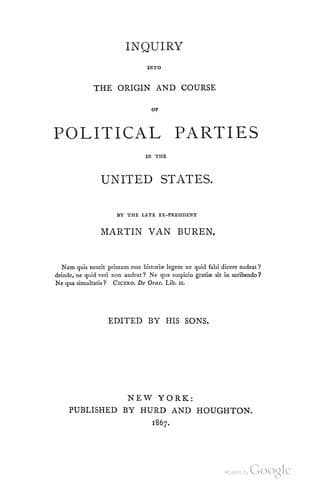
Inquiry Into the Origin and Course of Political Parties in the United StatesVan Buren, Martin
History
Inquiry Into the Origin and Course of Political Parties in the United States
Van Buren, Martin
Political parties -- United States
It thus appears that the opinions avowed to Mr. Jefferson on different
occasions, one of which seems to have been sought for the purpose, were
no more than repetitions of those he had avowed on the floor of the
Convention, and of which he knew that Mr. Madison possessed an authentic
record that would some day see the light; indeed, if such had not been
the fact he would have just as frankly repeated them, for they were the
settled convictions of his mind during his life--as fresh when they were
announced to Mr. Jefferson as when promulgated in the Convention. Nor
had he any motives for concealment of his views, if concealment had
been, as it was not, characteristic of the man, for he was equally
convinced that the government which had been established would prove a
failure, and that the wisdom of his plans and the propriety of adopting
them would thus become apparent to all.
We have here the words of General Hamilton himself--in his declarations
deliberately made and attested in the most solemn and responsible form
by Thomas Jefferson, and in his speech as reported by James Madison,
under still more specific responsibility, confirmed by his own notes for
that speech now published by his son and biographer--all going to the
same end, viz: to show that he was in principle a monarchist, and that
he preferred a monarchical to a republican form of government.
But Jefferson and Madison were politically his opponents. Let us now see
what his oldest and best friend says upon this point. Gouverneur Morris,
his coadjutor in the Convention and in politics through life, and his
eulogist at the grave, gave in 1811 an unreserved _exposé_ of Hamilton's
opinions on this very question, in a letter to Robert Walsh, then
editor of the "National Gazette," written, doubtless, in answer to
inquiries. The reader should procure this letter, and will find in it
much matter of interest. I omit, among other things, what it says in
respect to Hamilton's purity, and his frank and honorable character and
bearing in political matters, having said as much myself, and with no
less sincerity.
"General Hamilton," says Morris, "had little share in forming the
Constitution. He disliked it, believing all republican government to be
radically defective. He admired, nevertheless, the British Constitution,
which I consider an aristocracy in fact though a monarchy in name....
General Hamilton hated republican government because he confounded it
with democratical government, and he detested the latter because he
believed it must end in despotism, and be, in the mean time, destructive
to public morality.... But although General Hamilton knew these things
from the study of history, and perceived them by the intuition of
genius, he never failed on every occasion to advocate the excellence of,
and avow his attachment to monarchical government."
Public-domain text, read in full here on John Shaqi.
Reviews
Reviews
No reviews yet
Be the first to share your thoughts on this work.
Elsewhere in the archive
Join the Discussion
Join the discussion
Sign in to leave a comment or review.
Sign InorCreate an account