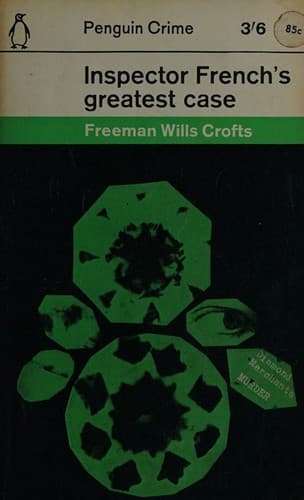
Detective and mystery stories; French, Joseph (Fictitious character) -- Fiction; Police -- Great Britain -- Fiction
“What do you mean, Emily? I don’t follow what you’re after.”
His wife ignored the interruption.
“And there’s another thing you might have thought of,” she continued.
“That Williams man thought he had seen the woman before. What age is
he?”
French was becoming utterly puzzled.
“What age?” he repeated helplessly. “I don’t know. About sixty, I should
think.”
“Just so,” said his wife. “And that other man, that Scarlett, he thought
he had seen her before. What age is he?”
The Inspector moved nervously.
“Really, Emily,” he protested, “I wish you’d explain what you’re getting
at. I don’t take your meaning in the least.”
“You would if you’d use your head,” his wife snapped. “What age is that
Scarlett?”
“About the same as the other—fifty-five or sixty. But what has that got
to do——”
“But the young fellow, that bank clerk; he didn’t remember her?”
“No, but——”
“Well, there you are—silly! What would a woman be who could make up
like another woman, and put on an English or American talk, and be
remembered by old Londoners? Why, a child could guess that, Watson!”
When Mrs. French called her husband by the name of the companion of the
great Holmes, it signified two things, first, that she was in what he
always referred to as “a good twist,” and secondly, that she felt
pleasantly superior, having seen something—or thinking she had—which
he had missed. He was therefore always delighted when a conversation
reached this stage, believing that something helpful was about to
materialise.
But on this occasion he grasped her meaning as soon as she had spoken.
Of course! How in all the earthly world had he missed the point? The
woman was an actress; a former London actress! That would explain the
whole thing. And if so, he would soon find her. Actors’ club secretaries
and attendants, theatrical agents, stage doorkeepers, the editors of
society papers—scores of people would have known her, and he would have
an easy task to learn her name and her history.
He jumped up and kissed his wife. “By Jove, Emily! You’re a fair
wonder,” he cried warmly, and she, still placidly knitting,
unsuccessfully attempted to hide the affection and admiration she felt
for him by a trite remark anent the folly of an old fool.
Next morning, French, with a new and thoroughly satisfactory programme
before him, sallied forth at quite the top of his form. He had made a
list of theatrical agencies at which he intended first to apply, after
which, if luck had up to then eluded him, he would go round the theatres
and have a word with the stage door keepers, finally applying to the
older actor-managers and producers and any one else from whom he thought
he might gain information.
But his quest turned out to be even simpler than he had dared to hope.
The superior young ladies of the first three agencies at which he called
shook their pretty heads over the photograph and could throw no light on
his problem. But at the fourth, the girl made a suggestion at which
French leaped.
Public-domain text, read in full here on John Shaqi.
Reviews
Reviews
No reviews yet
Be the first to share your thoughts on this work.
Elsewhere in the archive
Join the Discussion
Join the discussion
Sign in to leave a comment or review.
Sign InorCreate an account