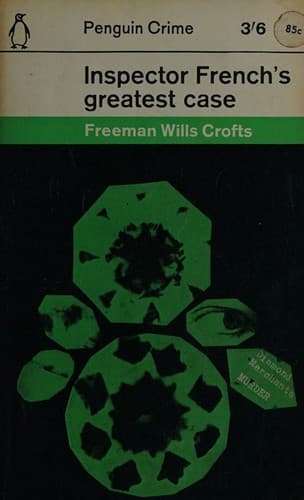
Detective and mystery stories; French, Joseph (Fictitious character) -- Fiction; Police -- Great Britain -- Fiction
At Rotterdam he took tickets for return via Hull, and travelling to
Leeds, put up at the Victory Hotel until the date of the sailing of the
_Enoch_. He and Miss Winter joined forces in the train between Leeds and
Liverpool, and on going on board the liner they attempted to throw any
pursuing detective off the scent by carrying out the same ruse by which
Duke had faked his suicide. They had taken two sets of tickets—one set
at Cook’s to Manáos in the name of Vane, and the other at the Booth Line
offices to Para in the name of da Silva, and had engaged staterooms and
tried to impress their personalities on the clerks on each occasion.
They had further provided themselves with sets of large and small
suitcases. The small ones, in which they packed their clothes and the
diamonds, they labelled “da Silva,” the large ones they labelled “Vane.”
They then put the “da Silva” suitcases inside the “Vane,” went on board
as Vane, and were shown to their cabin. As Vane, they went back to
purser and said they were going ashore. They went out on deck in the
direction of the gangway, but instead of crossing it they regained their
cabin, made up as the da Silvas, took out their small da Silva
suitcases, and slipping unseen from the cabin, returned to the Purser as
having just come on board.
The scheme as a whole worked out according to plan—save for Miss
Winter’s lapse in omitting to wait for and destroy the cipher
letter—but though the principals did not know it, a coincidence took
place which came within an ace of wrecking it. When Sylvia and
Harrington were driving home from the East End on the night of the crime
they saw Mr. Duke turn out of Hatton Garden into Holborn. He was
hurrying anxiously along the pavement with very different mien to his
usual upright, leisurely bearing. There was something furtive about his
appearance, and his face, revealed by a bright shaft of light streaming
from a confectioner’s shop, was drawn and haggard. Fearing some ill
news, Sylvia had stopped the taxi and hurried after him, but before she
had reached the pavement he had disappeared. She did not, however, take
the matter seriously until at breakfast the next morning he told her of
the crime. Even then it never occurred to her to suspect him; in fact,
she had forgotten the incident, but when he went on to state, as it were
casually, that he had been at his club all evening and had walked
directly home from there, she remembered. She realised that he was
lying, and suspicion was inevitable. In desperation lest Harrington
should unwittingly give away information which might put the police on
her father’s track, she rang him up and arranged an immediate meeting at
which she warned him of the possibilities. That afternoon Harrington
called to tell her how things had gone at the office, and then she had
overwhelmed him by insisting on the postponement of the wedding until
the affair should be cleared up. When, however, she learned that French
Public-domain text, read in full here on John Shaqi.
Reviews
Reviews
No reviews yet
Be the first to share your thoughts on this work.
Elsewhere in the archive
Join the Discussion
Join the discussion
Sign in to leave a comment or review.
Sign InorCreate an account