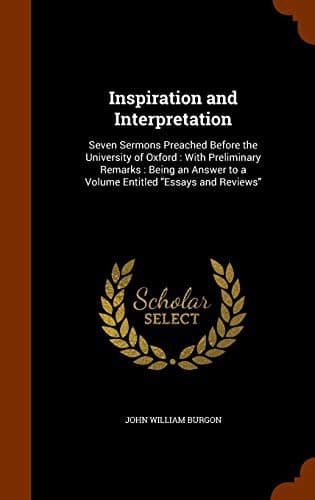
Inspiration and Interpretation: Seven Sermons Preached Before the University of OxfordBurgon, John William
Religion
Inspiration and Interpretation: Seven Sermons Preached Before the University of Oxford
Burgon, John William
Bible -- Criticism, interpretation, etc.; Bible -- Inspiration; Sermons, English
It is time to dismiss Mr. Pattison's Essay. In doing so, I will not
waste my time and yours by carping at the many errors of detail into
which he has (not inexcusably) fallen. These are the accidents,--not the
essence of his paper. The root of bitterness with the Author is, clearly
enough, _the Theory of Religious Belief in the Church of England_. His
concluding words shew this plainly. The sting of the Essay is in the
tail:--
"In the Catholic theory the feebleness of Reason is met half-way, and
made good by the authority of the Church. When the Protestants threw off
this authority, they did not assign to Reason what they took from the
Church, but to Scripture. Calvin did not shrink from saying that
Scripture 'shone sufficiently by its own light.' As long as this could
be kept to, the Protestant theory of belief was whole and sound. At
least it was as sound as the Catholic. In both, Reason, aided by
spiritual illumination, performs the subordinate function of recognising
the supreme authority of the Church, and of the Bible, respectively.
Time, learned controversy, and abatement of zeal, drove the Protestants
generally from the hardy but irrational assertion of Calvin. Every foot
of ground that Scripture lost was gained by one or other of the three
substitutes: Church-authority, the Spirit, or Reason. Church-authority
was essayed by the Laudian divines, but was soon found untenable, for on
that footing it was found impossible to justify the Reformation and the
breach with Rome." [O shame!] "The SPIRIT then came into favour along
with Independency. But it was still more quickly discovered that on such
a basis only discord and disunion could be reared. There remained to be
tried Common Reason, carefully distinguished from recondite learning,
and not based on metaphysical assumptions. To apply this instrument to
the contents of Revelation was the occupation of the early half of the
eighteenth century; with what success has been seen. In the latter part
of the century the same Common Reason was applied to the external
evidences. But here the method fails in a first
requisite,--universality; for even the shallowest array of historical
proof requires some book-learning to apprehend."--(pp. 328-9.)
Public-domain text, read in full here on John Shaqi.
Reviews
Reviews
No reviews yet
Be the first to share your thoughts on this work.
Elsewhere in the archive
Join the Discussion
Join the discussion
Sign in to leave a comment or review.
Sign InorCreate an account