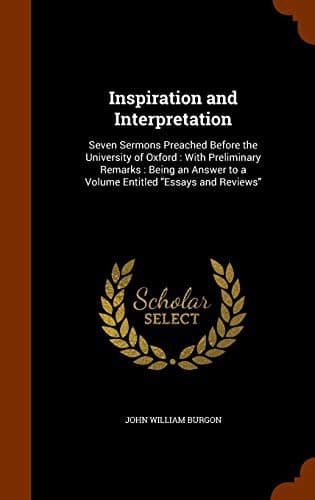
Inspiration and Interpretation: Seven Sermons Preached Before the University of OxfordBurgon, John William
Religion
Inspiration and Interpretation: Seven Sermons Preached Before the University of Oxford
Burgon, John William
Bible -- Criticism, interpretation, etc.; Bible -- Inspiration; Sermons, English
No one but a fool would set about the task which Mr. Pattison here
proposes. The current "religious literature _of the day_" cannot be
supposed, for an instant, to be an adequate exponent of the mind of the
Church of England,--or of any other Church. Revelation rests, at this
hour, on exactly the same basis on which it has always rested, and on
which it will rest, to the end of time; let the age be faithful, or
faithless,--learned or unlearned,--rationalizing or
scientific,--sceptical or superstitious,--or whatever else you will. And
if I am asked to explain myself, I would humbly say,--(always submitting
my own statements in such a matter to the judgment of the Bishops and
Doctors of the Church of England,)--that we receive the Bible on the
authority of _the Church_. The Church teaches us by the concurrent
voices of many Fathers, Doctors, Saints, how to interpret the Bible; and
convinces us that the three Creeds which she delivers to us as her own
independent tradition, may be proved thereby; being in entire conformity
with Holy Scripture, though not originally deduced from it.
"Self-evidencing" is hardly a correct epithet to bestow upon Scripture.
And yet, from the evidence which the New Testament supplies to the Old,
and from the interpretation which it puts upon its teaching, we should
not despair of proving the Truth of Revelation, to one who had neither
darkened the inward Light, nor perverted his Reason.
In truth, however, it is idle thus to speculate. We have been born into
the world during the nineteenth Century, whether we wish it or not. We
have been nourished, (GOD be thanked!) in the bosom of the Christian
Church, whether we would or no. The glory of the Gospel has informed our
natural reason, and we cannot undo the blessed process, strive we as
much as we will. The "inward Light," (as we call it,) is the lingering
twilight of the Day of Creation, in the case of the heathen,--the
reflected ray of the noontide of the Gospel, even in the case of the
modern unbeliever. We cannot escape from these conditions of our being,
although we may affect to ignore them, or pretend to turn our eyes the
other way. _No_ help however is to be rejected. _No_ faculty of the soul
need be denied the privilege of assisting to convince the doubting
heart. The inward Light may not be disparagingly spoken of: for what if
it should prove to be a ray sent down from the Father of Lights, to
illumine the dark places of the soul? The aid of Reason is not to be
excluded; for what is Faith but the highest dictate of the Reason?
Faith, (let us ever remember,) being opposed not to _Reason_, but to
_Sight_!... And who for a moment supposes that we disparage the office
of Reason, because we speak of the authority of the Church, in
controversies of Faith? We simply proclaim the Church to be the
appointed witness and keeper of Holy Writ; and when we are invited "_to
make out clearly_ on what basis Revelation is supposed to rest,"
(p.
Public-domain text, read in full here on John Shaqi.
Reviews
Reviews
No reviews yet
Be the first to share your thoughts on this work.
Elsewhere in the archive
Join the Discussion
Join the discussion
Sign in to leave a comment or review.
Sign InorCreate an account