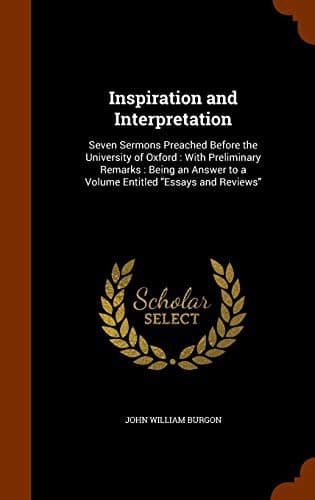
Inspiration and Interpretation: Seven Sermons Preached Before the University of OxfordBurgon, John William
Religion
Inspiration and Interpretation: Seven Sermons Preached Before the University of Oxford
Burgon, John William
Bible -- Criticism, interpretation, etc.; Bible -- Inspiration; Sermons, English
(=2=) Those many writings of the Old Testament are found to have been
collected into a single volume about four hundred years before the
Christian æra; when they were denominated by a common name, ἡ
γραφή,--"_The Scripture_[150];" and the supreme authority of the
writings so collected together, was axiomatic[151]. One arguing with His
Hebrew countrymen was able to appeal to a place in the Psalms, and to
remind them parenthetically that "the Scripture _cannot be
broken_[152],"--that is, might not be gainsaid, doubted, explained
away, or set aside.--Precisely similar phenomena are observable in
respect of the writings of the New Testament.
(=3=) Although the books of the Old Covenant are scattered at intervals
over the long period of upwards of a thousand years, the writers of the
later books are observed to quote the earlier ones, as if by a peculiar
secret sympathy: now, incorporating long passages,--now, simply adapting
one or two sentences,--now, blending allusive references. For some proof
of this assertion, (as far as I am able to produce it at a moment's
notice,) the reader is referred to the foot of the page[153].
The self-same phenomenon is observable with regard to the New Testament
Scriptures. Although all the books were written within so short a space
as about fifty years, the later writers quote the earlier ones to a
surprising extent. In the Gospels, the Gospels are quoted times without
number. In the Epistles, the Gospels are cited, or referred to, upwards
of sixty times. The Epistles contain many references to the
Epistles.--The phenomenon thus alluded to will also be found insisted
upon in a later part of the present volume[154].
"The fact, I believe, on close examination, will be found to stand
thus:--The Holy Bible abounds in quotations, even more perhaps than most
other books; but they are introduced in a way which is peculiar to
Revelation, and its own. When a Prophet or Apostle mentions one of his
own holy brethren, as when Ezekiel names Daniel, or Daniel Jeremiah;
when St. Peter speaks of St. Paul, or St. Paul of St. Peter, or of St.
Luke the Physician; _when they mention them, they do not quote them; and
when they quote them, they do not mention them_[155]."
Public-domain text, read in full here on John Shaqi.
Reviews
Reviews
No reviews yet
Be the first to share your thoughts on this work.
Elsewhere in the archive
Join the Discussion
Join the discussion
Sign in to leave a comment or review.
Sign InorCreate an account