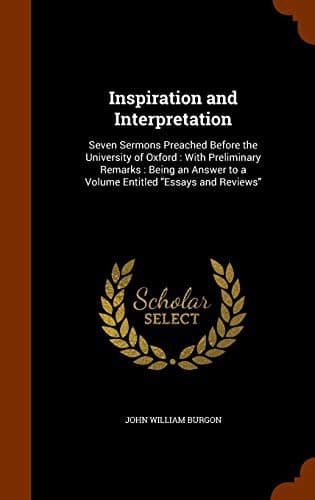
Inspiration and Interpretation: Seven Sermons Preached Before the University of OxfordBurgon, John William
Religion
Inspiration and Interpretation: Seven Sermons Preached Before the University of Oxford
Burgon, John William
Bible -- Criticism, interpretation, etc.; Bible -- Inspiration; Sermons, English
Very far am I from denying that "any one who, instead of burying himself
in the pages of the commentators, would learn the Sacred Writings by
heart, and paraphrase them in English, will probably make a nearer
approach to their true meaning than he would gather from any
Commentary." Quite certain is it that "the true use of Interpretation is
to get rid of interpretation, and leave us alone in company with the
author." (p. 384.) But this is quite a distinct and different matter, as
every person of unsophisticated understanding must perceive at once. The
same thing will be found stated by myself, in a subsequent part of the
present volume, at considerable length[206]; the qualifying condition
having been introduced at p. 16. The truth is, a man can no more divest
himself of the conditions of thought habitual to one familiar with his
Prayer-Book, than he can withdraw himself from the atmosphere of light
in which he moves. _Not_ the abuse of Commentators on Holy Scripture,
but _the principle on which Holy Scripture itself is to be
interpreted_,--is the real question at issue: the fundamental question
which underlies this, being of course the vital one,--namely, _Is the
Bible an inspired book, or not_?
Apart from what has been already urged concerning "the torrent of
_Patristic_ Interpretation[207]" which flows down not so much from the
fountain-head of Scripture, (wherein so many specimens of _Inspired_
Interpretation are preserved,) as from the fontal source of all Wisdom
and Knowledge,--even the lips of the Incarnate WORD Himself;--apart from
this, a very important Historical circumstance calls for notice in this
place.
How did Christianity originate? how did it first establish a footing in
the world? "The answer is, By the preaching of living men, who said they
were commissioned by GOD to proclaim it. _That_ was the origin and first
establishment of Christianity. There is indeed a vague and unreasoning
notion prevalent that Christianity was _taken from the New Testament_.
The notion is historically untrue. Christianity was widely extended
through the civilized world before the New Testament was written; and
its several books were successively addressed to various bodies of
Christian believers; to bodies, that is, who already possessed the faith
of CHRIST in its integrity. When, indeed, GOD ceased to inspire persons
to write these books, and when they were all collected together into
what we call the New Testament, the existing Faith of the Church,
derived from oral teaching, was tested by comparison with this Inspired
Record. And it henceforth became the standing law of the Church that
nothing should be received as necessary to Salvation, which could not
stand that test. But still, though thus tested, (every article being
proved by the New Testament,) Christianity is not taken from it; _for it
existed before it_.
Public-domain text, read in full here on John Shaqi.
Reviews
Reviews
No reviews yet
Be the first to share your thoughts on this work.
Elsewhere in the archive
Join the Discussion
Join the discussion
Sign in to leave a comment or review.
Sign InorCreate an account