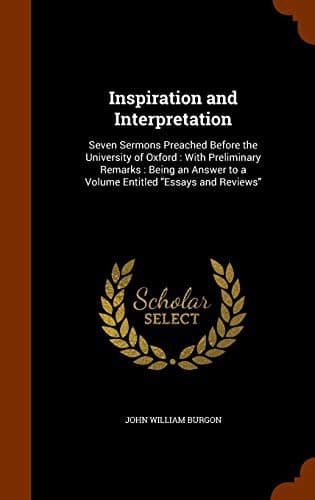
Inspiration and Interpretation: Seven Sermons Preached Before the University of OxfordBurgon, John William
Religion
Inspiration and Interpretation: Seven Sermons Preached Before the University of Oxford
Burgon, John William
Bible -- Criticism, interpretation, etc.; Bible -- Inspiration; Sermons, English
Now, to oppose to the learning, and piety, and wisdom, of every age of
the English Church,--to the unbroken testimony of the Church
Universal,--(3) to the torrent of Patristic Antiquity,--(4) the decision
of early Councils, and (5) the 'still small voice' of primitive
Creeds,--yet more, (6) to the constant practice of the Apostles,--and,
above all, (7) to the indisputable method of our Divine LORD
Himself;--to oppose to all this mighty accumulation of evidence, the
simple _à priori_ convictions of--Mr. Jowett! savours so strongly of the
ridiculous, that it really seems superfluous to linger over the
antithesis for a single moment.
$4.$ Our task might now be looked upon as completed.--It only remains,
in justice to the gentleman whose method we have been considering, to
ascertain by what considerations he is induced to reject that method of
Interpretation which, as we have seen, enjoys such overwhelming
sanction.
(i) In opposition to what goes before, then, he throws out a suggestion,
that "nothing would be more likely to restore a natural feeling on this
subject than a History of the Interpretation of Scripture. It would take
us back to the beginning; it would present in one view the causes which
have darkened the meaning of words in the course of ages." (p. 338-9.)
"Such a work would enable us to separate the elements of Doctrine and
Tradition with which the meaning of Scripture is encumbered in our own
day." (p. 339.)
Let us here be well understood with our author. The advantage of a good
"History of Interpretation" would indeed be incalculably great. But Mr.
Jowett, (like most other writers of his class,) _assumes_ the point he
has to _prove_, when he insinuates that the result of such a
contribution to our Theological Literature would be to shew that all the
world has been in error for 1700 years, and that he alone is right. That
'erring fancy' has _often_ been at work in the fields of sacred
criticism,--_who_ ever doubted? That there have been epochs of
Interpretation,--different Schools,--and varying tastes, in the long
course of so many centuries of mingled light and darkness, learning and
barbarism;--what need to declare? A faithful history of Interpretation
would of course establish these facts on a sure foundation.
But the Reverend Author forgets his Logic when he goes on from these
undoubted generalities to imply that all has been confusion and utter
uncertainty until now. Above all, common regard for the facts of the
case ought to have preserved him from putting forth so monstrous a
falsehood as the following:--"_Among German Commentators_ there is for
the first time in the history of the world, an approach to agreement and
certainty." (p. 340.)
Public-domain text, read in full here on John Shaqi.
Reviews
Reviews
No reviews yet
Be the first to share your thoughts on this work.
Elsewhere in the archive
Join the Discussion
Join the discussion
Sign in to leave a comment or review.
Sign InorCreate an account