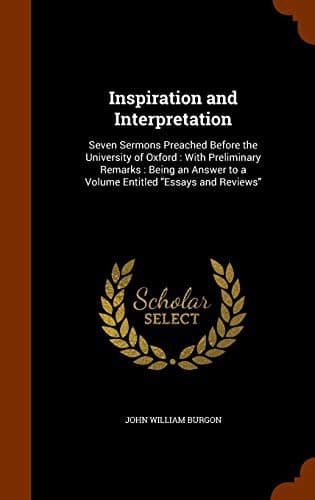
Inspiration and Interpretation: Seven Sermons Preached Before the University of OxfordBurgon, John William
Religion
Inspiration and Interpretation: Seven Sermons Preached Before the University of Oxford
Burgon, John William
Bible -- Criticism, interpretation, etc.; Bible -- Inspiration; Sermons, English
Now, the reader is requested to observe that what precedes is _the
direct contradictory_ of the position which Mr. Jowett has written his
Essay in order to establish. And thus we keep for ever coming back to
his πρῶτον ψεῦδος,--the fundamental falsity which underlies the whole
of what he has written.
(ii) But although we have eagerly resorted to Scripture itself in order
to ascertain _on what principle_ Scripture ought to be interpreted, we
cannot for a moment allow some of the sophistries with which the
Reverend Author has encumbered the question, to escape without
castigation. He may not first court an appeal to the School of
Apostolical Interpretation; and then, before the result of that appeal
has been ascertained, go off in praise of the illumination of the
present age; and claim to represent the Theological mind of Europe in
his own person. "Educated persons," (he has the impertinence to
assert,) "are _beginning to ask_ (!), not what Scripture may be _made_
to mean, but what it _does_. And it is no exaggeration to say that he
who in the present state of knowledge will confine himself to _the plain
meaning of words_, and the study of their context, may know more of the
original spirit and intention of the authors of the New Testament _than
all the controversial writers of former ages put together_."
(pp. 340-1.) This might be tolerated perhaps, in the self-constituted
oracle of a Mechanics' Institute; but as proceeding from a Divinity
Lecturer in one of the first Colleges in Oxford, I hesitate not to
declare that such an opinion is simply disgraceful.
Very much of a piece with this, in point of flippancy,--(though barely
consistent with his frequent assertions that the entire subject is
hemmed in by grave difficulties,)--are the Regius Professor of Greek's
remarks on the value of learning as a help to the Interpretation of Holy
Writ. "_Learning obscures_ as well as illustrates." (p. 337.)--"There
seem to be reasons for doubting whether any _considerable light_ can be
thrown on the New Testament from inquiry into _the language_."
(p. 393.)--"Minute corrections of tenses or particles are _no good_."
(p. 393.)--"Discussions respecting the chronology of St. Paul's life and
his second imprisonment; or about the identity of James, the brother of
the LORD; or, in another department, _respecting the use of the Greek
article,--have gone far beyond the line of utility_." (p. 393.) "The
minuteness of the study of Greek in our own day has also a tendency _to
introduce into the text associations_ which are not really found there."
(p. 391.)--Lastly, he complains of "the error of interpreting every
particle, as though it were a link in the argument; instead of being,
as is often the case, _an excrescence of style_." (p. 391.)
Public-domain text, read in full here on John Shaqi.
Reviews
Reviews
No reviews yet
Be the first to share your thoughts on this work.
Elsewhere in the archive
Join the Discussion
Join the discussion
Sign in to leave a comment or review.
Sign InorCreate an account