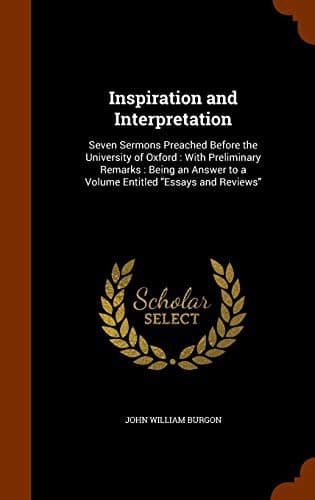
Inspiration and Interpretation: Seven Sermons Preached Before the University of OxfordBurgon, John William
Religion
Inspiration and Interpretation: Seven Sermons Preached Before the University of Oxford
Burgon, John William
Bible -- Criticism, interpretation, etc.; Bible -- Inspiration; Sermons, English
I shall be thought a very profane person, I dare say, by the friends and
apologists of Mr. Jowett, if I avow that the passage with which he
concludes his Essay, instead of sounding in my ears like the plaintive
death-song of departing Genius, sounds to me like nothing so much as the
piteous whine of a schoolboy who knows that he _deserves_ chastisement,
and perceives that he is about to experience his deserts. System, or
Theory, the Reverend Gentleman has none to propose. Views, except
negative ones, Mr. Jowett is altogether guiltless of. Can anybody in his
senses suppose that a man "has, by a Divine help (!), been enabled to
plant his foot _somewhere beyond the waves of Time_," (p. 433,) who
doubts everything, and believes nothing? Can any one of sane mind dream
that posterity will come to the rescue of a man who, when he is asked
for his story, rejoins, (with a well-known needy mechanic,) that he has
"none to tell, Sir?" _What_ then is posterity to vindicate? _What_ has
the Regius Professor of Greek written so many weak pages to prove? Just
nothing! If Mr. Jowett's Essay could enforce the message it carries, the
result would simply be that the world would become _dis_believers in the
Inspiration of the Bible: they would _dis_believe that Scripture has any
sense but that which lies on the surface: they would therefore
_dis_believe the Prophets and Evangelists and Apostles of CHRIST: they
would _dis_believe the words of our LORD JESUS CHRIST Himself!... Has
Mr. Jowett, then, grown grey under the laborious process of arriving at
this series of negations? When he anticipates "departing hence before
the natural term," does he mean that he is "_worn out with the
intellectual toil_" of propounding _nothing!_ and that he expects the
sympathy and gratitude of posterity for what he has propounded?
But this is not all. Instead of coming abroad, (if come abroad he must,)
in that garb of humility which befits doubt,--that self-distrust which
becomes one whose fault, or whose misfortune it is, that he simply
cannot believe,--Mr. Jowett assumes throughout, the insolent air of
intellectual superiority; the tone of one at whose bidding Theology must
absolutely 'keep moving.' A truncheon and a number on his collar, alone
seem wanting. The menacing voice, and authoritative air, are certainly
not away,--as I proceed to shew.
"It may be observed that a change in some of the prevailing modes of
Interpretation, is not so much a matter of expediency as _of necessity_.
The original meaning of Scripture _is beginning to be understood_."
(p. 418.)
"Criticism has _far more power_ than it formerly had. It has spread
itself over ancient, and even modern history.... _Whether Scripture can
be made an exception to other ancient writings_, now that the nature of
both is more understood; whether ... _the views of the last century will
hold out_,--these are questions respecting which" (p. 420.) it is hard
to judge.
Public-domain text, read in full here on John Shaqi.
Reviews
Reviews
No reviews yet
Be the first to share your thoughts on this work.
Elsewhere in the archive
Join the Discussion
Join the discussion
Sign in to leave a comment or review.
Sign InorCreate an account