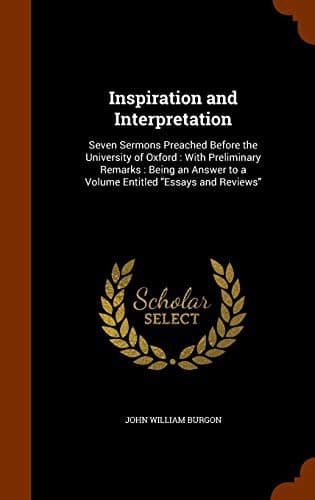
Inspiration and Interpretation: Seven Sermons Preached Before the University of OxfordBurgon, John William
Religion
Inspiration and Interpretation: Seven Sermons Preached Before the University of Oxford
Burgon, John William
Bible -- Criticism, interpretation, etc.; Bible -- Inspiration; Sermons, English
which we should seek to give the heathen;" "but the truth of the Book;
the mind of CHRIST and His Apostles, in which all lesser details and
differences should be lost and absorbed;" "the purer light or element of
Religion, of which Christianity is the expression." (p. 427.) ... Such
is the ghostly phantom, by the aid of which the Heathen are to become
evangelized!
But this historical Bible is not to be regarded as the rule of a man's
life, or indeed as an external Law at all. (pp. 36, 45.) "We walk now by
Reason and Conscience _alone_." (p. 21.) The Bible is to be identified
"with the voice of Conscience," (p. 45,)--which it has "to evoke, not to
override." (p. 44.) "The principle of private judgment ... makes
Conscience the supreme interpreter." (p. 45.) Ours is "a law which is
_not imposed upon us by another power_, but _by our own enlightened
will_:" (p. 35:) for the "Spirit, or Conscience" "legislates" henceforth
"_without appeal except to himself_." (p. 31.)
Having thus disposed of "Traditional Christianity," (p. 156,) it is not
obscurely hinted that something quite different is to be substituted in
its place. And first, next to "a frank appeal to Reason, and a frank
criticism of Scripture," (p. 174,) the nature and "office of the Church
is to be properly understood." (p. 194.)
The Church then is a spontaneous development of the State, as "part of
its own organization," (p. 195,)--a purely secular Institution. The
State will "develop itself into a Church" by "throwing its elements, or
the best of them, into another mould; and constituting out of them a
Society, which is in it, though in some sense not of it (?),--which is
another (?), yet the same." (p. 194.) The nation must provide, from time
to time, that the teaching of one age does "not traditionally harden, so
as to become an exclusive barrier in a subsequent one; and so the moral
growth of those who are committed to the hands of the Church be
checked." (_Ibid._) The Church is founded, therefore, not upon "the
possession of a supernaturally communicated speculation (!) concerning
GOD," but "upon _the manifestation of a Divine Life in Man_."
"Speculative doctrines should be left to _philosophical schools_. A
national Church must be concerned with the _ethical development_ of its
members." (p. 195.) It should be "free from dogmatic tests, and similar
intellectual bondage;" (p. 168;) hampered by no Doctrines, pledged to no
Creeds. These may be retained indeed; but "_we refuse to be bound by
them_." (p. 44.) The Subscription of the Clergy to the Articles should
also be abolished: for "no promise can reach fluctuations of opinion,
and personal conviction." (!!!) _Open_ heretical teaching may, to be
sure, be dealt with by the Law; but the Law "should not require any act
which appears to signify 'I think.'" (p. 189.) Witness "the reluctance
of the stronger minds to enter an Order in which their intellects may
not have _free play_." (p. 190.) ... Such then is the Negative Religion!
Public-domain text, read in full here on John Shaqi.
Reviews
Reviews
No reviews yet
Be the first to share your thoughts on this work.
Elsewhere in the archive
Join the Discussion
Join the discussion
Sign in to leave a comment or review.
Sign InorCreate an account