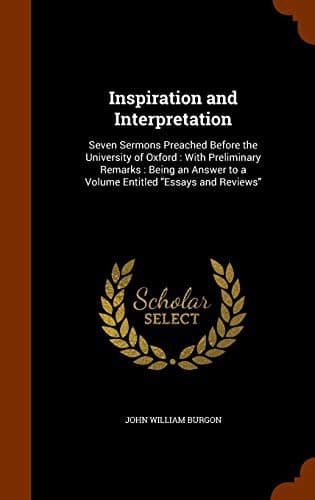
Inspiration and Interpretation: Seven Sermons Preached Before the University of OxfordBurgon, John William
Religion
Inspiration and Interpretation: Seven Sermons Preached Before the University of Oxford
Burgon, John William
Bible -- Criticism, interpretation, etc.; Bible -- Inspiration; Sermons, English
[128] "There have been found within the area of these islands upwards of
15,000 species of once living things, _every one differing specifically
from those of the present Creation_. Agassiz states that, with the
exception of one small fossil fish, (discovered in the clay-stones of
Greenland,) _he has not found any creature of this class, in all the
Geological strata, identical with any fish now living_." (Pattison's
_The Earth and the World_, p. 27.)
[129] I allude to such passages as the following,--all of which are to
be found in Mr. Goodwin's Essay:--
"We are asked to believe that a vision of creation was presented to him
(Moses) by Divine power, for the purpose of enabling him to inform the
world of what he had seen; which vision inevitably led him to give a
description which has misled the world for centuries, and in which the
truth can now only with difficulty be recognized." (p. 247.) "The
theories [of Hugh Miller and of Dr. Buckland] assume that appearances
only, not facts, are described; and that, in riddles which would never
have been suspected to be such, had we not arrived at the truth from
other sources." (p. 249.) "For ages, this simple view of Creation
satisfied the wants of man, and formed a sufficient basis of theological
teaching:" but "modern research now shews it to be physically
untenable." (p. 253.)
"The writer asserts solemnly and unhesitatingly that for which he must
have known that he had no authority." But this was only because "the
early speculator was harassed by no such scruples" as "arise from our
modern habits of thought, and from the modesty of assertion (!) which
the spirit of true science has taught us." He therefore "asserted as
facts what he knew in reality only as probabilities.... He had seized
one great truth.... With regard to details, observation failed
him."--(pp. 252-3.)
[130] p. 329.
[131] pp. 307-309.
[132] Notice prefixed to _Essays and Reviews_.
[133] p. 255.
[134] Nos. 74, 76, 78, 81.
[135] I allude particularly to the late Hugh James Rose, B.D.
[136] Neh. iv. 17, 18.
[137] St. Luke xviii. 8.
[138] See Nelson's _Life of Bull_, p. 329, &c.
[139] See his admirable Preface.
[140] Newman's dedication of his 'Lectures on Romanism and popular
Protestantism.'
[141] See the 'Monitum' prefixed to Dr. Routh's _Testimonia De
Auctoritate S. Scripturæ Ante-Nicæna.--Reliqq. Sacræ_, vol. v. p. 335.
[142] "In 1781, the first Sunday School was established in England by
Robert Raikes, a publisher and bookseller in Gloucester."--National
Society's _Circular_.
[143] _Primary Charge_, at the end of his _Sermons_.
[144] Rev. M. Pattison, in _Essays and Reviews_, p. 307.
[145] pp. 338, 375, 420 top line, 428, &c.
[146] See all this very ably and interestingly explained in an article
reprinted from the 'Christian Remembrancer' (Jan. 1861,) _On certain
Characteristics of Holy Scripture_, by the Rev. J. G. Cazenove, p. 11,
&c.
Public-domain text, read in full here on John Shaqi.
Reviews
Reviews
No reviews yet
Be the first to share your thoughts on this work.
Elsewhere in the archive
Join the Discussion
Join the discussion
Sign in to leave a comment or review.
Sign InorCreate an account