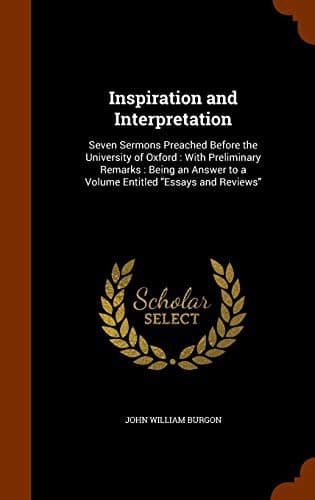
Inspiration and Interpretation: Seven Sermons Preached Before the University of OxfordBurgon, John William
Religion
Inspiration and Interpretation: Seven Sermons Preached Before the University of Oxford
Burgon, John William
Bible -- Criticism, interpretation, etc.; Bible -- Inspiration; Sermons, English
2. Somewhat less obvious, but not less true, is the unattractive aspect,
at first sight, of the Gospel. Verily there is, until we become
intimately acquainted with it, "no beauty that we should desire"
it.--The style, (full of interest, to those who have tried to understand
it a little,) is not, I suppose, what critics would call altogether a
good style.--The Greek is not what learned men call _pure_.--Many a
word, (brimfull of meaning to those who will give to the words of the
Gospel their best care,) reminds one, that neither did _He_ speak what,
in the capital of Jewry, was accounted a classical idiom. He employed
the accent of the despised Galilee.--The very reasoning, (until you give
it your heart's homage and best attention,) often seems to be either
inconsequential, or to contain a fallacy. Certain words of our LORD have
been even _cited_ as fallacious by a celebrated Divine whose writings we
are all familiar with[255]. Now, _His_ words were disregarded, cavilled
at, made light of, in just the same manner.
3. Most surprising of all is the analogy observable between the union of
the Divine and the human element in the Gospels,--and the strictly
parallel union, as it seems, of the two natures, the Divine and the
Human, in the person of our LORD.--As _He_ was perfect and faultless, so
do we deem _it_ infallible also, without spot or blemish of any kind. We
reject as monstrous any 'theory of Inspiration,' (as it is called,)
which imputes blunders to the work of the HOLY GHOST.--As, further, we
claim for our LORD'S recorded human actions mysterious significancy, so
do we seem warranted in looking for a mysterious purpose, a divine
meaning, in every expression of the written Word.--Lastly, although we
may, nay we must, admit such a Divine and such a human element, we must
altogether deny the possibility of separating the one from the other. We
cannot separate Scripture into human and Divine. Like the Incarnate
WORD, the Gospel is at once both human _and_ Divine, yet one and
indivisible. And the method of its inspiration is as great a difficulty
in its way, and as much beyond our ken, as the nature of the union of
the Godhead and the Manhood in the one person of CHRIST.
Public-domain text, read in full here on John Shaqi.
Reviews
Reviews
No reviews yet
Be the first to share your thoughts on this work.
Elsewhere in the archive
Join the Discussion
Join the discussion
Sign in to leave a comment or review.
Sign InorCreate an account