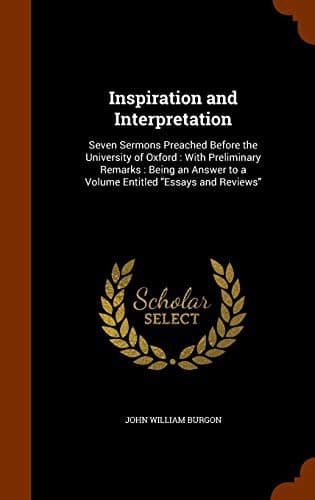
Inspiration and Interpretation: Seven Sermons Preached Before the University of OxfordBurgon, John William
Religion
Inspiration and Interpretation: Seven Sermons Preached Before the University of Oxford
Burgon, John William
Bible -- Criticism, interpretation, etc.; Bible -- Inspiration; Sermons, English
But _that_ is not exactly what St. Paul says. The Greek for _that_,
would be πᾶσα Ἡ γραφή--not πᾶσα γραφὴ--θεόπνευστός. St. Paul does
not say that _the whole_ of Scripture, collectively, is inspired. More
than _that_: what he says is, that _every writing_,--every _several
book_ of those ἱερὰ γράμματα, or Holy Scriptures, in which Timothy had
been instructed from his childhood,--is inspired by God[331]. It _comes_
to very nearly the same thing; but it is _not_ quite the same thing. St.
Paul is careful to remind us that every Book in the Bible is an inspired
Book[332]. And this statement is not confined to one place.--Elsewhere,
he calls his message "the Word of GOD;" and says that it had been
received by the disciples not as the Word of Men, but as it is in truth,
the Word of GOD[333].--Elsewhere, "Which things also we speak, not in
the words which man's wisdom teacheth, but which the HOLY GHOST
teacheth[334]:"--where, if I at all understand the Apostle, (and he
speaks very plainly!) he says that _his words_ were inspired by the HOLY
GHOST.--Accordingly, St. Peter declares that the Epistles of his
"beloved brother Paul" are part of the Holy Scriptures[335];--Divinely
inspired, therefore, like all the rest.
But does not St. Paul himself in a certain place express a doubt--saying
"I _think_ that I have the Spirit of GOD[336]?" and does he not contrast
his own sayings with the Divine sayings, ("not I but the LORD[337]"),
clearly implying that his own were _not_ Divine? and does he not say
that he delivers certain things "by permission, and not of
commandment[338]," whereby he seems to insinuate a gradation of
authority in what he delivers?--No. Not one of these things does he do.
He says, indeed, of a certain hint to married persons that he offers it
"by way of _advice_ to them not by way of _precept_:" but _giving
advice_ to _men_ is a very different thing from _receiving permission_
from GOD. Again, "Unto the married," (he says,) "I command, yet not I
but the LORD,"--alluding to our LORD'S words, as set down by St.
Matthew, chap. xix. verse 6[339]; which is simply an historical allusion
to the Gospel.--So far from "_thinking_" he had the Spirit of GOD, (as
if it were an open question whether he had it or not,) he says the very
contrary. Δοκέω, in all such places, implies, not _doubt_ but
_certainty[340]_: (as when our LORD asks,---"Doth he thank that servant
because he did the things commanded him? οὐ δοκῶ,"--I fancy not
indeed[341]!) On St. Paul's lips, as every scholar knows, the phrase is
not one of doubt, but one of indignant, or at least emphatic
asseveration[342].--A man had need be very sure he _understands_ the
record, (let me just remark in passing,) before he presumes to criticize
it.
Public-domain text, read in full here on John Shaqi.
Reviews
Reviews
No reviews yet
Be the first to share your thoughts on this work.
Elsewhere in the archive
Join the Discussion
Join the discussion
Sign in to leave a comment or review.
Sign InorCreate an account