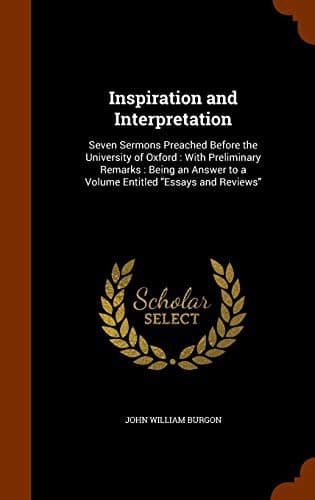
Inspiration and Interpretation: Seven Sermons Preached Before the University of OxfordBurgon, John William
Religion
Inspiration and Interpretation: Seven Sermons Preached Before the University of Oxford
Burgon, John William
Bible -- Criticism, interpretation, etc.; Bible -- Inspiration; Sermons, English
If you will take the trouble to compare any of the cases,--in Genesis
for example,--where a conversation is first set down, and then reported
by one of the speakers,--you will find that it is deemed allowable to
omit or to add clauses, even when the discourse is related in the first
person[368]. Something before inserted, is withheld: or something before
withheld, is inserted. No discourse was probably ever set down, word for
word, as it was delivered. In sacred, as in profane writings, the exact
_substance_, or rather, the real _purport_, of what was spoken, very
reasonably stands for what was _actually_ spoken. The difference is
this;--that a narrative, by man abridged, _may_ convey a wrong
impression: whereas an inspired abridgement of any history soever
_cannot_ mislead.
Other characteristics of an inspired narrative,--the lesser Laws of the
Divine Harmony, as they may be called,--will be discovered by the
attentive reader. For example, that intervening circumstances are often
passed over, without any notice taken of them whatever: while yet it is
singular how often the Evangelist shews himself conscious of what he
omits by some very minute allusion to it[369]. This must suffice
however. It would require a whole sermon, a whole volume rather, to
enumerate all the features of the Evangelical method.
II. The next sample of difficulty will not occupy us long. St. Matthew
is charged with a bad memory, because he ascribes to "Jeremy the
prophet[370]" words which are said to be found in Zechariah.--Strange
that men should be heard to differ about a plain matter of fact! _I_
have never been able to find these words in Zechariah yet!... There are
words _something like them_,--but not those very words, by any
means,--in Zech. xi. 12. Why then is St. Matthew to be taxed with a bad
memory? Are there not other prophecies quoted in the New Testament not
to be found in the Old? Yes[371]. Is not the self-same prophecy
sometimes found in two different prophets,--as in Isaiah and Nahum?
Yes[372]. Are not some prophetic passages _common to Jeremiah and
Zechariah?_ Yes[373]. The Jews even had a saying that the Spirit of the
one was in the other. _Where_ then remains a pretence for supposing that
St. Matthew was troubled with a bad memory?
Public-domain text, read in full here on John Shaqi.
Reviews
Reviews
No reviews yet
Be the first to share your thoughts on this work.
Elsewhere in the archive
Join the Discussion
Join the discussion
Sign in to leave a comment or review.
Sign InorCreate an account