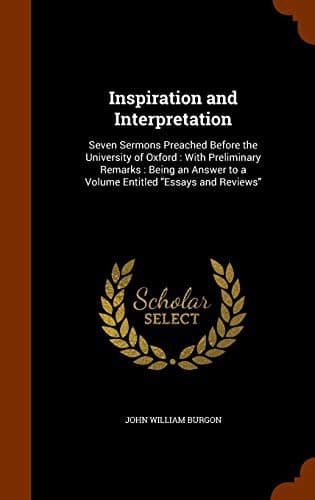
Inspiration and Interpretation: Seven Sermons Preached Before the University of OxfordBurgon, John William
Religion
Inspiration and Interpretation: Seven Sermons Preached Before the University of Oxford
Burgon, John William
Bible -- Criticism, interpretation, etc.; Bible -- Inspiration; Sermons, English
You cannot possibly mean what you say. You will not pretend to assert
that the list of the Dukes of Edom[393], is as much inspired,--inspired
in _the same sense_,--as the Gospel of St. John.--To which I make
answer, that I believe one to be just as much inspired as the other: and
before I leave off, I will endeavour to bring my hearers to the same
opinion. In the meantime, it is only fair to the objector, to hear him
out: to follow his guidance; and to see whither he would lead us. It
will be quite competent for us _then_ to retrace our steps; to point out
"a more excellent way;" and to entreat him, with all a brother's
earnestness, to reconsider the matter, and to follow _us_.
The objection may, I believe, be fairly stated as follows.--It is
unreasonable to consider any part of Holy Scripture inspired which the
author was competent to write without the aid of Inspiration. Just as
you would not multiply miracles needlessly, and ascribe to special
Divine interference results which might be otherwise accounted for, so
neither ought you to call in the aid of Inspiration where it may clearly
be dispensed with. A genealogy,--a catalogue of names, whether of places
or persons,--whatever may reasonably be suspected to have been an
extract from public Archives;--nothing of this sort need you, nor
indeed, properly speaking, _can_ you, call "inspired." More than that.
All mere narratives of ordinary transactions,--or indeed of transactions
extraordinary;--whatever, in short, a writer, having first beheld it
with his eyes, appears to have simply described with his pen, it is
unreasonable to regard as the work of Inspiration. For it is plain to
common sense,--(so at least I have heard it said,) that there is much,
both in the Old and in the New Testament, the delivery of which required
no other than the ordinary gifts of men:--actual observation, good
memory, high intellect, clearness of statement, honesty of purpose. Look
at the preface to St. Luke's Gospel. It seems only to convey that the
author of it believed himself to be bringing out a superior edition of a
narrative which had already been attempted by many. I would apply, (it
is said,) to the whole of the Old Testament the same observations which
I apply to the New. There are parts which evidently required nothing but
opportunity of experience, or research, and the ordinary qualities of a
trustworthy historian.--This then is the way the case is put. There is
no intentional irreverence on the part of the objector: no conscious
hostility to GOD'S Truth. Very much the reverse. But having once
assumed that the catalogue of the Dukes of Edom is not to be regarded as
an inspired document, he has logical consistency enough to perceive that
he cannot exactly stop _there_. And so, he carries his speculations a
little further. He tries to take (what he calls) a "common sense" view
of the question. He says that he thinks it a dangerous proceeding on the
Public-domain text, read in full here on John Shaqi.
Reviews
Reviews
No reviews yet
Be the first to share your thoughts on this work.
Elsewhere in the archive
Join the Discussion
Join the discussion
Sign in to leave a comment or review.
Sign InorCreate an account