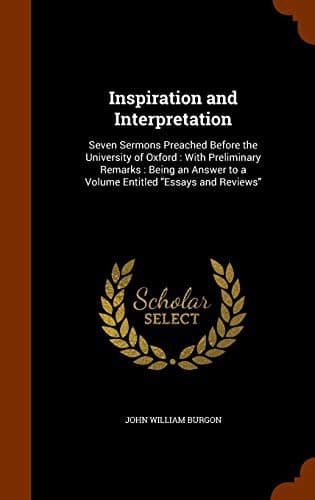
Inspiration and Interpretation: Seven Sermons Preached Before the University of OxfordBurgon, John William
Religion
Inspiration and Interpretation: Seven Sermons Preached Before the University of Oxford
Burgon, John William
Bible -- Criticism, interpretation, etc.; Bible -- Inspiration; Sermons, English
But we may go on faster, and use the knife far more freely. Every thing
in the Pentateuch of which Moses had been an eye or ear-witness, and
which he set down from his own personal knowledge, may be eliminated
from the Bible, as not inspired. According to the principle already
enunciated by yourself, I call upon you to excise from the Book of GOD'S
Law, Exodus, and Leviticus, and Numbers, and Deuteronomy: those passages
only excepted which are prophetical,--as the xxxiiird of Deuteronomy.
Joshua must go of course: for if the son of Nun did not write the Book
which goes under his name,--(as the wise men in Germany say, or used to
say, he did not[394],)--of course the narrative is not authentic; and if
he _did_, _you_ say that it ought not to be regarded as inspired. Judges
and Ruth cannot hope to stand; for they are mere stories,--narratives of
events which any contemporary author who enjoyed "actual observation,
good memory, high intellect, clearness of statement, and honesty of
purpose," was abundantly qualified--(according to _your_ view of the
matter)--to commit to writing. The Books of Samuel and of Kings cannot
be claimed as the work of Inspiration, of course. Chronicles we have got
rid of already. No imaginable plea can be invented for the Books of
Ezra, of Nehemiah, and of Esther; those writings having evidently
required nothing (to use your own phrase) but "opportunity of experience
or research, and the ordinary qualities of a trustworthy historian." The
prophetical books you spare; natural piety suggesting that since
"Prophecy came not in old time by the will of man, but holy men of GOD
spake as they were moved by the HOLY GHOST[395];"--the writings of
Isaiah and the rest, must be retained as inspired. We expunge those
portions only which are simply historical and moral; since to these, by
the hypothesis, the spirit of Inspiration cannot be thought to have
extended.
We come now to the New Testament; and two of the Gospels are found to be
mutilated already, by the elimination of one chapter of St. Matthew and
one of St. Luke. But on the principle that personal observation, a good
memory, honesty of purpose, and so forth, are the only requirements
necessary, we may proceed to carry forward the work of excision with
spirit, so that we be but careful to use discernment. For example, we
may begin with the Call of St. Matthew, and the Feast which he made to
our LORD in his own house. _Who_ so competent to relate this, as the
Evangelist himself? Whenever, in short, the Twelve were present, St.
Matthew, (as one of the Twelve,) may be assumed to have written from
personal observation; and _that_ portion of his narrative is to be
rejected accordingly as uninspired.
Public-domain text, read in full here on John Shaqi.
Reviews
Reviews
No reviews yet
Be the first to share your thoughts on this work.
Elsewhere in the archive
Join the Discussion
Join the discussion
Sign in to leave a comment or review.
Sign InorCreate an account