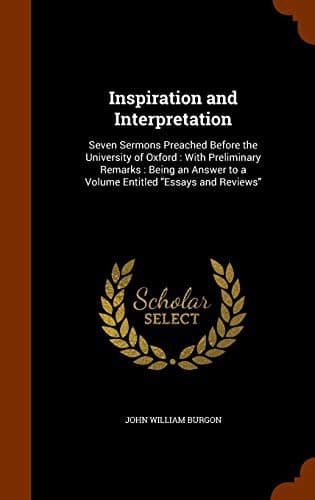
Inspiration and Interpretation: Seven Sermons Preached Before the University of OxfordBurgon, John William
Religion
Inspiration and Interpretation: Seven Sermons Preached Before the University of Oxford
Burgon, John William
Bible -- Criticism, interpretation, etc.; Bible -- Inspiration; Sermons, English
5. This entire matter may be usefully illustrated by having recourse to
an analogy which was established on a former occasion: namely, the
analogy between the _Written_ and the _Incarnate_ Word[398]. That our
LORD JESUS CHRIST is at once very GOD and very Man, we all fully admit;
although _the manner_ of the union of GODHEAD and Manhood in His one
Person we confess ourselves quite unable to comprehend. Even so, that
there is a human as well as a Divine element in Holy Scripture,--_who_
so blind as to overlook? _who_ so weak as to deny? And yet, to dissect
out that human element,--_who_ (but a fool) so rash as to attempt?... To
apply this to the matter before us. _Certain parts_ of Holy Scripture
you think, (for reasons to yourself best known,) are not to be looked
upon as inspired in the same sense as the rest of the volume. Just as
reasonably might you try to persuade me that our SAVIOUR was not _in the
same sense_ our SAVIOUR when He ate and drank at the Pharisees' board,
as when He cast out devils and raised the dead. Was He not equally the
Incarnate WORD at every stage of His earthly career; from the time that
He was laid in the manger, until the instant when He expired upon the
Cross? The degradation which He endured in Pilate's judgment-hall did
not affect the reality of the great truth that the GODHEAD was
indissolubly joined to the Manhood in His Person. He was not less very
GOD as well as very Man when some one spat upon Him, than at His
Transfiguration and at His Ascension into Heaven!... Why then should the
mean aspect and lowly office of certain parts of
Scripture,--(genealogical details and the narrative of what we think
ordinary occurrences,)--be supposed to disentitle those parts to the
praise of being _as fully inspired as any thing in the whole compass of
the Bible?_
I may remind you, in passing, that the narrative of Scripture, even in
its humblest, and (to all appearance) most human parts, has a perpetual
note of Divinity set upon it. The historical portions are throughout
interspersed with indications that the writer is beholding the
transactions which he records, from a Divine, (not a human,) point of
view. GOD is invariably, (sooner or later,) mentioned as the Agent; or
there is some reference made to GOD; or to GOD'S Word. As Butler
expresses it,--"The general design of Scripture ... may be said to be,
to give us an account of the world, in this one single view,--_as GOD'S
world_: by which it appears essentially distinguished from all other
books, so far as I have found, except such as are copied from it[399]."
Public-domain text, read in full here on John Shaqi.
Reviews
Reviews
No reviews yet
Be the first to share your thoughts on this work.
Elsewhere in the archive
Join the Discussion
Join the discussion
Sign in to leave a comment or review.
Sign InorCreate an account