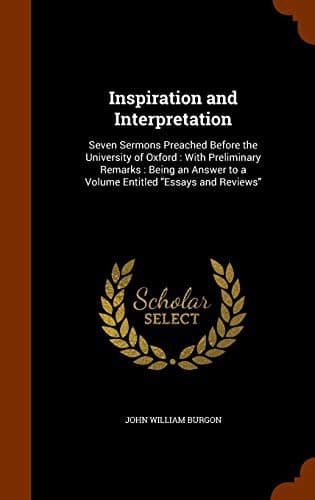
Inspiration and Interpretation: Seven Sermons Preached Before the University of OxfordBurgon, John William
Religion
Inspiration and Interpretation: Seven Sermons Preached Before the University of Oxford
Burgon, John William
Bible -- Criticism, interpretation, etc.; Bible -- Inspiration; Sermons, English
I illustrated sufficiently, last time, in what way fulness of
Inspiration is consistent with the expression of individual character:
even while I availed myself of the ancient illustration that an inspired
writer is like an instrument in the harper's hand[403]. I did not, of
course, "intend thereby to affirm that the Writers of Holy Scripture
were _constrained_ to write, without any volition or consciousness on
their part.... ALMIGHTY GOD, while He _inspired_ the Writers of
Scripture, did not impair their moral and intellectual faculties, nor
destroy their personal identity[404]." Let me not be told therefore that
this is to advocate a mechanical theory of Interpretation. Theory I have
none[405]. The Bible comes to me as the Word of GOD; and, _as the Word
of GOD_, (the LORD being my helper!) I will receive it. I should as soon
think of holding a theory of Providence and Freewill, as of holding a
theory of Inspiration. I _believe_ in Providence. I _know_ that I am a
free agent. And that is enough for me.--The case of Inspiration seems
strictly parallel. I _believe_ in the Divine origin of the Bible. I
_see_ that the writers of the several books wrote like men.... _That_
outer circle of causation, which, leaving each individual will entirely
free, so controuls without coercing, so overrules without occasioning,
the actions of men,--that all things shall work together for good in the
end, and the great designs of GOD'S Providence find free
accomplishment;--all this, far, far transcends your and my powers of
comprehension. It is as much beyond us as Heaven is higher than the
Earth. And, in like manner, we must be content to own that
Inspiration,--the analysis of which is so favourite a problem with this
inquisitive age,--is far, far above us likewise. To St. Luke "it seemed
good" to write a Gospel; and doubtless he held high communing on the
subject,--which may, or may not, have sounded like ordinary human
converse,--with St. Paul. St. Mark in like sort, beyond a question,
enjoyed the help of St. Peter, while he wrote his Gospel. But St. Peter
and St. Mark, and St. Paul and St. Luke, were all alike,--however
unconsciously,--held by the Ancient of Days within the hollow of His
palm; and, as Augustine says,--"Whatsoever He willed that _we_ should
read concerning His acts and sayings,--_that_ He commissioned the
Evangelists to write,--as though it had been _Himself_ that wrote
it[406]."--The guidance was remote, I grant you. The mechanism which
moved the pens of those blessed writers was far above out of their
sight; and complex beyond anything which the mind of man can imagine;
(so that the publican lisped of "gold, and silver, and brass[407];"--and
the companion of St. Peter, at Rome, wrote Latin words in Greek
letters[408];--and the Physician of Antioch withheld the statement that
the woman who had spent all that she had in consulting many physicians,
"was nothing bettered, but rather grew worse[409];"--and the beloved
Public-domain text, read in full here on John Shaqi.
Reviews
Reviews
No reviews yet
Be the first to share your thoughts on this work.
Elsewhere in the archive
Join the Discussion
Join the discussion
Sign in to leave a comment or review.
Sign InorCreate an account