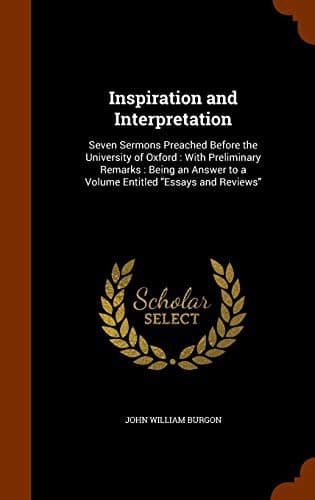
Inspiration and Interpretation: Seven Sermons Preached Before the University of OxfordBurgon, John William
Religion
Inspiration and Interpretation: Seven Sermons Preached Before the University of Oxford
Burgon, John William
Bible -- Criticism, interpretation, etc.; Bible -- Inspiration; Sermons, English
1. Now, the first thing which strikes one in this theory, is its extreme
vagueness. We hardly know what we have to consider; for nothing is
definitely stated. Neither are we informed how many of the phenomena of
Inspiration, this view is intended to explain. Again, does the theory
apply equally to the Old Testament and to the New? If it does apply
equally to the Old Testament, (and I can see no possible reason why it
should _not_,) then, I apprehend this theory will be found _practically_
to run up into, and to identify itself with, that last described[418].
For a guidance _which has failed to guide_, has been no guidance at all;
and since whole chapters of the Old Testament will occur to every one's
memory which may be thought to have no connexion whatever with
'Christian Doctrine,'--to conduce wondrous little to the 'making men
wise unto Salvation,'--it will follow that Inspiration is, according to
this theory, in effect, of the nature already described,--namely, a
quality which can never be predicated of any passage of Scripture with
entire certainty. The larger part of the Old Testament in fact, by this
theory, is exhibited in the light of a common book; having no pretension
to be regarded as part of the Inspired Canon.
But if this theory simply shirks the question of the Old Testament,
then, those who are inclined to accept it, are bound to explain why
there should be one theory of Inspiration applicable to the Old
Testament, and another for the New:--in which difficulty, I must
candidly profess that I am not able to render any assistance at all. It
is clearly not allowable to overlook the intimate connexion which
subsists between the two great divisions of Holy Scripture; the habitual
references of the Writers of the New Testament to the writers of the
Old,--Moses, David, Isaiah, and the rest;--or rather, _to the utterance
of the_ HOLY GHOST, _speaking by the mouth of those writers_. Whatever
may have been the Inspiration of the Authors of the New Testament must
be assumed to have been that of the Authors of the Old Testament also.
2. But further,--(to confine our remarks to the Scriptures of the New
Testament; which, it is manifest, the view under consideration specially
contemplates;)--however plausible in the abstract a theory may sound,
which would account for a Chronological difficulty,--the insertion of
what seems to be a wrong name,--a quotation made with singular
license,--an unscientific statement,--the apparent inconsistency of two
or more accounts of one and the same transaction, in respect of lesser
details,--a (supposed) inconclusive remark, or specimen of reasoning
which seems to be fallacious;--on the supposition that it is not the
office of Inspiration to enlighten the understanding on points like
these, or to preserve the pen from error;--however plausible, I say,
this theory, abstractedly considered, may appear;--it will be found that
it will not bear the searching test of a practical application.
Public-domain text, read in full here on John Shaqi.
Reviews
Reviews
No reviews yet
Be the first to share your thoughts on this work.
Elsewhere in the archive
Join the Discussion
Join the discussion
Sign in to leave a comment or review.
Sign InorCreate an account