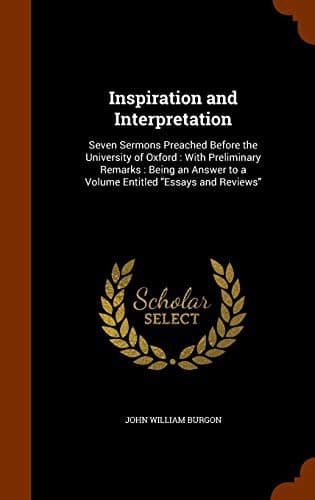
Inspiration and Interpretation: Seven Sermons Preached Before the University of OxfordBurgon, John William
Religion
Inspiration and Interpretation: Seven Sermons Preached Before the University of Oxford
Burgon, John William
Bible -- Criticism, interpretation, etc.; Bible -- Inspiration; Sermons, English
But if, on the other hand, the pen be freely used, then the result will
be fatal to the theory, _because it will be fatal to the record_. If
an 'Essayist and Reviewer' were to reduce the Gospels to consistency,
according to _his_ view of consistency, the Gospels would scarcely be
recognizable. If he were to reject from St. Paul's writings every
instance of what _he_ thinks fanciful exposition, illogical reasoning,
inexact quotation, and mistaken inference; the result would be
altogether unmanageable. For any one who attends to the matter will
perceive that such things run into the very staple of the Apostle's
argument; and therefore cannot be detached without destroying the whole.
The householder's reason for not removing the tares, ("lest while ye
gather up the tares ye root up also the wheat with them[425],") applies
exactly. If St. Paul's exposition of Melchizedek be fanciful and
untrustworthy, then does the proof of the superiority of our SAVIOUR'S
Priesthood over that of Aaron, fall to the ground. If his handling of
the story of Sarah and Hagar be an uninspired allegory, then does his
argumentation respecting the rejection of the Jews and the calling of
the Gentiles disappear. If the furniture of the Temple, and the
provisions of the Jewish ritual, were not dictated by the SPIRIT of
GOD[426], then will the Epistle wherein it is found be reduced to
proportions which make it meaningless. If Deuteronomy xxv. 4 has no
reference to the Christian Ministry, then the entire context (in two of
St. Paul's Epistles) must go at once[427].... It is useless to multiply
such instances. Any one familiar with the writings of St. Paul will know
the truth of what has been offered; and will admit that the erasures
required by the theory before us will become so numerous as to
prove,--(to a devout mind at least, or indeed to any one of sense and
candour,)--that the theory is altogether untenable.
It cannot escape observation, therefore, that however plausible this
view of Inspiration may sound, as long as some few petty historical,
chronological, and scientific inaccuracies are all that have to be
accounted for;--the theory (unhappily) proves worthless when it comes to
be practically applied; inasmuch as in the writings of St. Paul, for
example, there is little or nothing of the kind just specified, to be
condoned. Erroneous dates, unscientific statements, wrong names, and the
like, form no part of the staple of the New Testament. Such instances
may be counted on one's fingers; and are to be sufficiently explained to
render any special theory of Inspiration in order to meet them, quite a
gratuitous exercise of ingenuity.
Public-domain text, read in full here on John Shaqi.
Reviews
Reviews
No reviews yet
Be the first to share your thoughts on this work.
Elsewhere in the archive
Join the Discussion
Join the discussion
Sign in to leave a comment or review.
Sign InorCreate an account