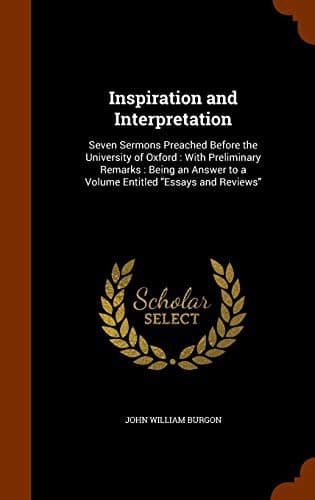
Inspiration and Interpretation: Seven Sermons Preached Before the University of OxfordBurgon, John William
Religion
Inspiration and Interpretation: Seven Sermons Preached Before the University of Oxford
Burgon, John William
Bible -- Criticism, interpretation, etc.; Bible -- Inspiration; Sermons, English
6. Let me also advert to a dilemma which seems hardly ever to obtain
from a certain class of critics the attention it deserves. If a writing
be not inspired, _it is of no absolute authority_. If a part of a
writing be not inspired, that part is of no absolute authority. If a
single word in the text of Holy Scripture be even uncertain,--(as, for
example, whether we are to read ΟΣ or ΘΕΟΣ in 1 Tim. iii.
16,)--_that word becomes without absolute authority_. We cannot venture
to adduce it _in proof_ of anything. Without therefore, in the remotest
degree, desiring to discourage the application of a _true_ theory of
Inspiration to the phenomena of Holy Scripture, through fear of the
necessary consequences,--may we not call attention to the manifest
awkwardness of a theory which no one knows how to apply, and about the
application of which no two men will ever be agreed?--the issue of the
discussion being, in every case, neither more nor less than
this,--whether the portion of Scripture under consideration is Human,
and therefore _of no absolute authority_; or Divine, and therefore
_infallible_!
7. A far more important consideration remains to be offered, and with
this I shall conclude. Although, when St. Paul appears to reason
inconclusively, some of us do not hesitate to refer the Apostle's
(supposed) imperfect logic to his personal infirmity,--yet, common piety
revolts against the proposal to apply the same solution to the same
phenomenon when it is observed to occur in the Discourses of our Blessed
LORD Himself. It seems to have been providentially ordained, however,
that the discourses of CHRIST Himself should supply examples of every
one of those difficulties which it is thought lawful to account
for,--when an Apostle or an Evangelist is the speaker,--on the
hypothesis of partial, imperfect, or suspended Inspiration. Now, since
_I_, at least, shall not be permitted to be either vague or general, I
proceed to subjoin the proof of what has been thus advanced:--
=1=. The well-known difficulty about "the days of Abiathar," _is found
in one of our LORD'S discourses_[428]. Here then is a case of what, if
an Evangelist or an Apostle had been the author of the statement, would
have been called an historical inaccuracy.
=2=. However unworthy of scientific attention the Mosaic account of the
descent of Mankind from a single pair may be deemed,--the universality
of 'the Noachian Deluge,'--the destruction of the Cities of the
plain,--the fate of Lot's wife,--Jonah in the fish's belly,--and so
forth;--to all these (supposed) unscientific statements our Blessed LORD
commits Himself unequivocally[429].
Public-domain text, read in full here on John Shaqi.
Reviews
Reviews
No reviews yet
Be the first to share your thoughts on this work.
Elsewhere in the archive
Join the Discussion
Join the discussion
Sign in to leave a comment or review.
Sign InorCreate an account