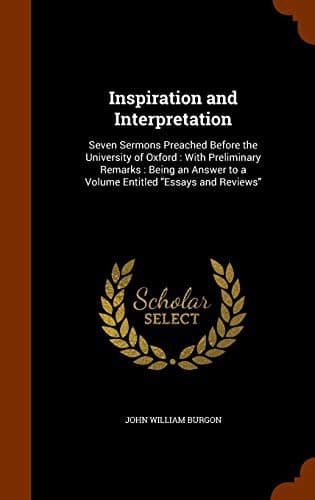
Inspiration and Interpretation: Seven Sermons Preached Before the University of OxfordBurgon, John William
Religion
Inspiration and Interpretation: Seven Sermons Preached Before the University of Oxford
Burgon, John William
Bible -- Criticism, interpretation, etc.; Bible -- Inspiration; Sermons, English
[397] "With the idea of a Prophet," (says Gesenius in his Hebrew
Lexicon, on the noun,) "there was this necessarily attached; that he
spoke not his own words, but those which he had divinely received; (see
Philo, t. iv. p. 116, ed. Pfeifferi,--προφήτης γὰρ ἴδιον μὲν οὐδὲν
ἀποφθέγγεται, ἀλλότρια δὲ πάντα ὑπηχοῦντος ἑτέρου); and that he was the
messenger of GOD, and the declarer of His will. This is clear from a
passage of peculiar authority in this matter, (Ex. vii. 1,)--where GOD
says to Moses,--'I have made thee a god to Pharaoh; and Aaron thy
brother _shall be thy prophet_.'" ... Elsewhere, (speaking of the Hebrew
verb, 'to prophesy,') Gesenius has the following remarkable
statement:--"The _passive forms_, Niphal and Hithpael, are used in this
verb; from the Divine Prophets having been _supposed to be moved rather
by another's powers than their own_." (Just as if the Oracles of GOD
were not express on the subject! viz. "No prophecy ever came by the will
of Man; but, [because they were] borne along (φερόμενοι) by the HOLY
GHOST, spake those holy men of GOD."--2 St. Pet. i. 21.)
Προφήτης, in fact, means 'an interpreter' rather than 'a prophet,'
(for which, in our popular sense, the Greek is rather μάντις:) hence
the use of the words προφήτης, προφητεύω, προφητεία in the New
Testament, e.g. 1 Thess. v. 20. 1 Cor. xi. 4: xii. 10. Rom. xii. 6,
(where see Wordsworth.) See also 1 Cor. xiv. 1, 3, 4, 5, &c.: in all
which places, the προφήτης was what we should rather now call _a
preacher_. But then, the expounding of GOD'S Word is the special
function of the preacher's office from which he takes this name.--The
reader is referred to Blomfield's Glossary, _Agam._ v. 399, and to
Liddell and Scott's _Lexicon_; (in both of which, some important
references are given:) also to Trench's _Synonyms of the New Testament_,
pp. 22-26.
[398] See above, pp. 2-5.--The reader will find an interesting passage
based on this analogy, in the Appendix (F).
Public-domain text, read in full here on John Shaqi.
Reviews
Reviews
No reviews yet
Be the first to share your thoughts on this work.
Elsewhere in the archive
Join the Discussion
Join the discussion
Sign in to leave a comment or review.
Sign InorCreate an account