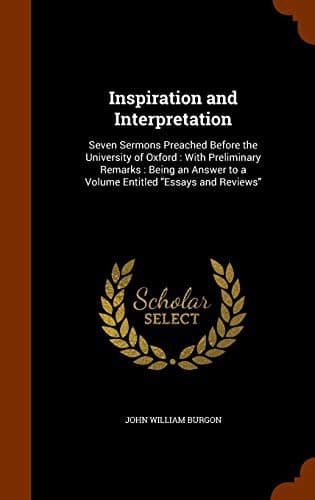
Inspiration and Interpretation: Seven Sermons Preached Before the University of OxfordBurgon, John William
Religion
Inspiration and Interpretation: Seven Sermons Preached Before the University of Oxford
Burgon, John William
Bible -- Criticism, interpretation, etc.; Bible -- Inspiration; Sermons, English
6. But I cannot dismiss the typical character of the Scripture
narrative, until I have reminded you of one striking intimation of it
which you might easily overlook. "O fools and slow of heart," was our
LORD'S reproof to Cleophas and his companion on the evening of the first
Easter: "Ought not CHRIST to have suffered these things, and to enter
into His Glory? And _beginning at Moses_ and all the Prophets, He
expounded unto them in all the Scriptures the things concerning
Himself[483]." In like manner, St. Paul at Rome expounded to the
unbelieving Jews, "persuading them concerning JESUS both _out of the Law
of Moses_ and out of the Prophets, from morning till evening[484]." The
same thing is repeated elsewhere[485]: but the most express declaration
is that of our LORD Himself to the Jews:--"Had ye believed Moses, ye
would have believed Me; _for he wrote of Me_[486]," Moses therefore
_wrote concerning_ CHRIST. CHRIST Himself says so. But _where?_ Shew me
the places in the Pentateuch which prove that CHRIST was "to suffer
these things" and then to "enter into glory?" You cannot do it; unless
indeed in Isaac's Sacrifice you are content to find the adumbration of
the scene on Calvary. You cannot do it; unless in Joseph's betrayal for
twenty pieces of silver, (the deed of another Judas!) and his letting
down into the pit without water, you recognize the image of the death of
One by the blood of whose Covenant the prisoners of hope were set
free[487]. You cannot do it; unless in the same Joseph's exaltation to
the supreme power of Egypt, (when they "cried before him, Bow the
knee!") you behold MESSIAH'S session at the Right Hand of GOD. You
cannot do it; unless you notice how "Joseph, who was ordained to save
his Brethren from death, who would have slain _him_, did represent the
SON of GOD, who was slain by us and yet dying saved us[488]." You cannot
do it; unless in the Paschal Lamb, and the wave-sheaf, you discern
things Heavenly, and of eternal moment. You cannot do it; unless you
remember "that as, in order to consecrate the Harvest by offering to GOD
the first-fruits of it, a sheaf was lifted up and waved; as well as a
Lamb offered on that day by the priest to GOD; so MESSIAH, that
immaculate Lamb which was to die, that Priest which dying was to offer
up Himself to GOD, was upon the same day lifted up and raised from the
dead; or rather shook and lifted up, and presented Himself to GOD, and
so was accepted for us all; that so our dust might be sanctified, our
corruption hallowed, our mortality consecrated to eternity." Many who
hear me will perceive that I have been quoting from Bp. Pearson; and
will be constrained to admit that Isaac and Joseph,--the wave-sheaf and
the Paschal Lamb,--may well be types of CHRIST; and that, thus lightly
touched, there can be little objection to tracing in such histories and
provisions of the Law, the main outlines of the Life and Death and
Resurrection of our REDEEMER. But remember, we have handled wondrous
Public-domain text, read in full here on John Shaqi.
Reviews
Reviews
No reviews yet
Be the first to share your thoughts on this work.
Elsewhere in the archive
Join the Discussion
Join the discussion
Sign in to leave a comment or review.
Sign InorCreate an account