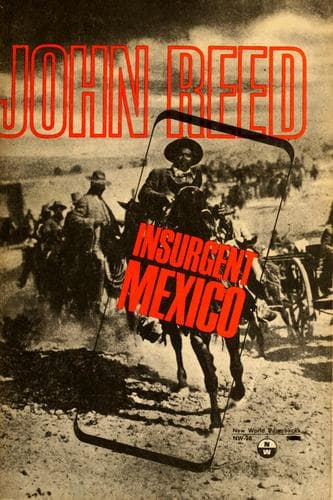
Mexico -- History -- 1910-1946; Mexico -- History -- Revolution, 1910-1920
We could reconstruct this man’s last struggle. He had dropped off his
horse, wounded—for there was blood on the ground—into a little dry
arroyo. We could even see where his horse had stood while he pumped
shells into his Mauser with feverish hands, and blazed away, first to
the rear, where the pursuers came running with Indian yells, and then at
the hundreds and hundreds of bloodthirsty horsemen pouring down from the
north, with the Demon Pancho Villa at their head. He must have fought a
long time, perhaps until they ringed him round with living flame—for we
found hundreds of empty cartridges. And then, when the last shot was
spent, he made a dash eastward, hit at every step; hid for a moment
under the little railroad bridge, and ran out upon the open desert,
where he fell. There were twenty bullet holes in him. They had
stripped him of all save his underclothes. He lay sprawled in an
attitude of desperate action, muscles tense, one fist clenched and
spread across the dust as if he were dealing a blow; the fiercest
exultant grin on his face. Strong, savage, until one looked closer and
saw the subtle touch of weakness that death stamps on life—the delicate
expression of idiocy over it all. They had shot him through the head
three times—how exasperated they must have been!
Crawling south through the cold night once more.... A few miles and then
a bridge dynamited, or a strip of track wrecked. The stop, the dancing
torches, the great bonfires leaping up from the desert, and the four
hundred wild men pouring furiously out and falling upon their work....
Villa had given orders to hurry....
About two o’clock in the morning I came upon two _soldaderas_ squatting
around a fire, and asked them if they could give me _tortillas_ and
coffee. One was an old, gray-haired Indian woman with a perpetual grin,
the other a slight girl not more than twenty years old, who was nursing
a four-months baby at her breast. They were perched at the extreme tip
of a flat-car, their fire built upon a pile of sand, as the train jolted
and swayed along. Around them, backed against them, feet sticking out
between them, was a great, inconglomerate mass of sleeping, snoring
humans. The rest of the train was by this time dark; this was the only
patch of light and warmth in the night. As I munched my _tortilla_ and
the old woman lifted a burning coal in her fingers to light her
corn-husk cigarette, wondering where her Pablo’s brigade was this night;
and the girl nursed her child, crooning to it, her blue-enameled
ear-rings twinkling,—we talked.
Public-domain text, read in full here on John Shaqi.
Reviews
Reviews
No reviews yet
Be the first to share your thoughts on this work.
Elsewhere in the archive
Join the Discussion
Join the discussion
Sign in to leave a comment or review.
Sign InorCreate an account