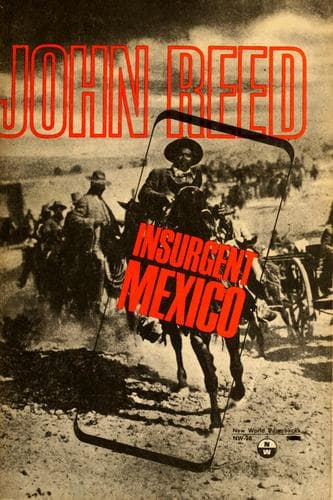
Mexico -- History -- 1910-1946; Mexico -- History -- Revolution, 1910-1920
Tuesday, early in the morning, the army was in motion again toward the
front, straggling down the track and across the field. Four hundred
raging demons sweated and hammered at the ruined track; the foremost
train had made half a mile in the night. Horses were plenty that
morning, and I bought one, saddle and all, for seventy-five pesos—about
fifteen dollars in gold. Trotting down by San Ramon, I fell in with two
wild-looking horsemen, in high sombreros, with little printed pictures
of Our Lady of Guadelupe sewed on the crowns. They said they were going
out to an outpost upon the extreme right wing, near the mountains above
Lerdo, where their company was posted to hold a hill. Why should I want
to come with them? Who was I, anyway? I showed them my pass, signed by
Francisco Villa. They were still hostile. "Francisco Villa is nothing
to us,", they said. "And how do we know whether this is his name,
written by him? We are of the Brigada Juarez, Calixto Contreras’
_gente_." But after a short consultation the taller grunted, "Come."
We left the protection of the trees, striking out diagonally across the
ramparted cotton-fields, due west, straight for a steep, high hill that
already quivered in the heat. Between us and the suburbs of Gomez
Palacio stretched a barren, flat plain, covered with low mesquite and
cut by dry irrigation ditches. The Cerro de la Pila, with its murderous
concealed artillery, lay perfectly quiet, except that up one side of it,
so clear was the air, we could make out a little knot of figures
dragging what looked like a cannon. Just outside of the nearest houses
some horsemen were riding around; we immediately struck north, making a
wide detour, carefully on the watch, for this intermediate ground was
overrun by pickets and scouting parties. About a mile beyond, almost
along the foot of the hill, ran the high road from the north to Lerdo.
We reconnoitered this carefully from the brush. A peasant passed
whistling, driving a flock of goats. On the very edge of this road,
under a bush, was an earthen jar full of milk. Without the least
hesitation the first soldier drew his revolver and shot. The jar split
into a hundred pieces—milk spurting everywhere.
"Poisoned," he said briefly. "The first company stationed over here
drank some of that stuff. Four died." We rode on.
Up on the hill crest a few black figures squatted, their rifles tilted
against their knees. My companions waved to them, and we turned north
along the bank of a little river that unrolled a narrow strip of green
grass in the midst of desolation. The outpost was camped on both sides
of the water, in a sort of meadow. I asked where the colonel was, and
finally found him stretched out in the shade of a tent that he had made
by hanging his serape over a bush.
Public-domain text, read in full here on John Shaqi.
Reviews
Reviews
No reviews yet
Be the first to share your thoughts on this work.
Elsewhere in the archive
Join the Discussion
Join the discussion
Sign in to leave a comment or review.
Sign InorCreate an account