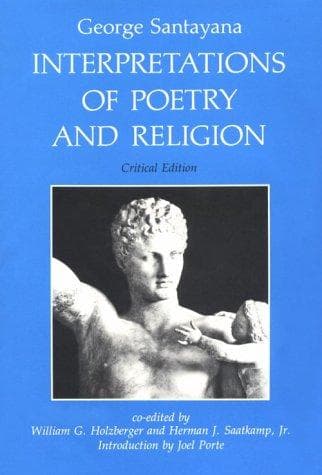
Interpretations of Poetry and ReligionSantayana, George
Religion
Interpretations of Poetry and Religion
Santayana, George
Aesthetics; Literature -- History and criticism; Poetry; Religion
Against such fatuity reason should raise her voice. The vital and
historic forces that produce illusions of this sort in large groups of
men are indeed beyond the control of criticism. The ideas of passion
are more vivid than those of memory, until they become memories in
turn. They must be allowed to fight out their desperate battle against
the laws of Nature and reason. But it is worth while in the meantime,
for the sake of the truth and of a just philosophy, to meet the varying
though perpetual charlatanism of the world with a steady protest. As
soon as Browning is proposed to us as a leader, as soon as we are asked
to be not the occasional patrons of his art, but the pupils of his
philosophy, we have a right to express the radical dissatisfaction
which we must feel, if we are rational, with his whole attitude and
temper of mind.
The great dramatists have seldom dealt with perfectly virtuous
characters. The great poets have seldom represented mythologies that
would bear scientific criticism. But by an instinct which constituted
their greatness they have cast these mixed materials furnished by life
into forms congenial to the specific principles of their art, and by
this transformation they have made acceptable in the æsthetic sphere
things that in the sphere of reality were evil or imperfect: in a word,
their works have been beautiful as works of art. Or, if their genius
exceeded that of the technical poet and rose to prophetic intuition,
they have known how to create ideal characters, not possessed, perhaps,
of every virtue accidentally needed in this world, but possessed of
what is ideally better, of internal greatness and perfection. They
have also known how to select and reconstruct their mythology so as to
make it a true interpretation of moral life. When we read the maxims
of Iago, Falstaff, or Hamlet, we are delighted if the thought strikes
us as true, but we are not less delighted if it strikes us as false.
These characters are not presented to us in order to enlarge our
capacities of passion nor in order to justify themselves as processes
of redemption; they are there, clothed in poetry and imbedded in plot,
to entertain us with their imaginable feelings and their interesting
errors. The poet, without being especially a philosopher, stands by
virtue of his superlative genius on the plane of universal reason, far
above the passionate experience which he overlooks and on which he
reflects; and he raises us for the moment to his own level, to send
us back again, if not better endowed for practical life, at least not
unacquainted with speculation.
Public-domain text, read in full here on John Shaqi.
Reviews
Reviews
No reviews yet
Be the first to share your thoughts on this work.
Elsewhere in the archive
Join the Discussion
Join the discussion
Sign in to leave a comment or review.
Sign InorCreate an account