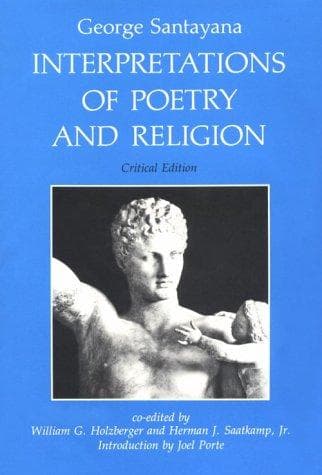
Interpretations of Poetry and ReligionSantayana, George
Religion
Interpretations of Poetry and Religion
Santayana, George
Aesthetics; Literature -- History and criticism; Poetry; Religion
There is never anything largely composed in the spirit of pure beauty,
nothing devotedly finished, nothing simple and truly just. The poet's
mind cannot reach equilibrium; at best he oscillates between opposed
extravagances; his final word is still a _boutade_, still an explosion.
He has no sustained nobility of style. He affects with the reader a
confidential and vulgar manner, so as to be more sincere and to feel
more at home. Even in the poems where the effort at impersonality is
most successful, the dramatic disguise is usually thrown off in a
preface, epilogue or parenthesis. The author likes to remind us of
himself by some confidential wink or genial poke in the ribs, by some
little interlarded sneer. We get in these tricks of manner a taste of
that essential vulgarity, that indifference to purity and distinction,
which is latent but pervasive in all the products of this mind. The
same disdain of perfection which appears in his ethics appears here in
his verse, and impairs its beauty by allowing it to remain too often
obscure, affected, and grotesque.
Such a correspondence is natural: for the same powers of conception
and expression are needed in fiction, which, if turned to reflection,
would produce a good philosophy. Reason is necessary to the perception
of high beauty. Discipline is indispensable to art. Work from which
these qualities are absent must be barbaric; it can have no ideal form
and must appeal to us only through the sensuousness and profusion of
its materials. We are invited by it to lapse into a miscellaneous
appreciativeness, into a subservience to every detached impression. And
yet, if we would only reflect even on these disordered beauties, we
should see that the principle by which they delight us is a principle
by which an ideal, an image of perfection, is inevitably evoked. We
can have no pleasure or pain, nor any preference whatsoever, without
implicitly setting up a standard of excellence, an ideal of what
would satisfy us there. To make these implicit ideals explicit, to
catch their hint, to work out their theme, and express clearly to
ourselves and to the world what they are demanding in the place of the
actual--that is the labour of reason and the task of genius. The two
cannot be divided. Clarification of ideas and disentanglement of values
are as essential to æsthetic activity as to intelligence. A failure of
reason is a failure of art and taste.
Public-domain text, read in full here on John Shaqi.
Reviews
Reviews
No reviews yet
Be the first to share your thoughts on this work.
Elsewhere in the archive
Join the Discussion
Join the discussion
Sign in to leave a comment or review.
Sign InorCreate an account