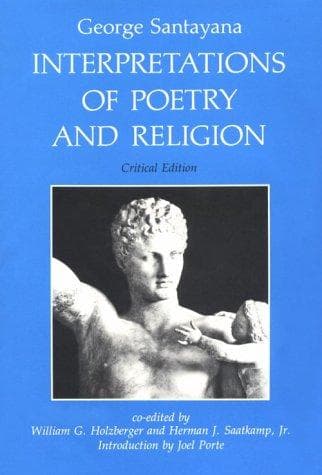
Interpretations of Poetry and ReligionSantayana, George
Religion
Interpretations of Poetry and Religion
Santayana, George
Aesthetics; Literature -- History and criticism; Poetry; Religion
The form is literary and the outcome in a sense negative; there is
no attempt to put new wine into old bottles, no apologetic tone, no
unction. Experience is consulted afresh, without preoccupation as to
the results of reflection; and if these results are religious, it is
because any reasoned appreciation of life is bound to be a religion,
even if no conventionally religious elements are imported into the
problem. In fact, those prophets who have said that the Sabbath was
made for man and who have given moral functions to historical religion,
as well as those philosophers who have best understood its nature, have
seemed irreligious to their contemporaries, because they have looked
upon religion as an interpretation of reality, not as a quasi-reality
existing by itself and vouched for merely by tradition and miracle.
Religion is an imaginative echo of things natural and moral: and if
this echo is to be well attuned, our ear must first be attentive to the
natural sounds of which, in religion, we are to develop the harmony.
It is, therefore, not an objection to Jean Lahor's competence to
gather for us the elements of a religion that he is a poet rather
than a theologian and an observer rather than a philosopher, or that
he presents his intuitions without technical apparatus in a series of
highly coloured epigrams and little pictures. On the contrary such
simplicity and directness are an advantage when, as in this case, the
guiding inspiration is religious. It is religious because, on the one
hand, it is imaginative; we are asking ourselves everywhere what Nature
says to us and what we are to say in reply; and on the other hand,
because it is rational, and these messages and reactions are to be
unified into a single science and a single morality. The logical scheme
of the system is not made explicit: there is no argumentation and no
answers are offered to the objections that might naturally suggest
themselves. But the sayings are so arranged and made so to progress
in tone and subject that a system of philosophy is clearly implied in
them; and the essence of this system is at times briefly expressed.
Public-domain text, read in full here on John Shaqi.
Reviews
Reviews
No reviews yet
Be the first to share your thoughts on this work.
Elsewhere in the archive
Join the Discussion
Join the discussion
Sign in to leave a comment or review.
Sign InorCreate an account