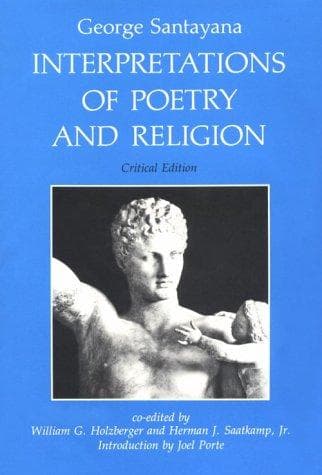
Interpretations of Poetry and ReligionSantayana, George
Religion
Interpretations of Poetry and Religion
Santayana, George
Aesthetics; Literature -- History and criticism; Poetry; Religion
The answer, to be adequate, would have to be long; but perhaps we
may indicate the spirit in which it ought to be conceived. Paganism
was a religion, but was discarded because it was not supernatural:
Neo-Platonism could not be maintained because it was not a religion.
Christianity was both. It had its roots in a national faith, moulded
by the trials and passions of a singularly religious people; that
connection with Judaism gave Christianity a foothold in history, a
definite dogmatic nucleus, which it was a true instinct in the Church
never to abandon, much as certain speculative heresies might cry out
against the unnatural union of a theory of redemption with one of
creation, and of a world-denying ascetic idealism, which Christianity
was essentially, with the national laws, the crude deism, and the
strenuous worldliness of the ancient Jews. However, had the Gnostic
or Manichæan heresies been victorious, Christianity would have been
reduced to a floating speculation: its hard kernel of positive dogma,
of Scripture, and of hieratic tradition would have been dissolved. It
would have ceased to represent antiquity or to hand down an ancestral
piety: in fine, by its eagerness to express itself as a perfect
philosophy, it would have ceased to be a religion. How essential an
element its Hebraism was, we can see now by the study of Protestantism,
a group of heresies in which the practical instincts and sentimental
needs of the Teutonic race found expression, by throwing over more or
less completely the Catholic dogma and ritual. Yet in this revolution
the Protestants maintained, or rather increased, the intensity of their
religious consciousness, chiefly by absorbing the elements of Hebrew
law and prophecy which they could find in the Bible and casting into
that traditional form their personal conscience or their national
ideals.
How inadequate, on the other hand, this Hebraic element would have
been to constitute the supernatural religion that was now needed,
appears very clearly from the case of Philo Judæus. Here was a man,
heir to all the piety and fervour of his race, who at the same time
was a Neo-Platonist three hundred years before Plotinus and, as it
were, the first Father of the Church. But his religion, being national,
was not communicable and, being positivistic, was at fundamental odds
with the spirit of his philosophy. It remained, therefore, as a merely
personal treasure and heirloom, the possession of his private life:
his disciples, had he had any, must either have been Jews themselves
or else must have been the followers merely of his philosophy. His
religion could not have passed to them; they would have regarded it, as
we might regard the Christianity of Kant or the wife-worship of Comte,
as a private circumstance, a detached trait, less damaging, perhaps, to
his philosophy than favourable to his loyal heart.
Public-domain text, read in full here on John Shaqi.
Reviews
Reviews
No reviews yet
Be the first to share your thoughts on this work.
Elsewhere in the archive
Join the Discussion
Join the discussion
Sign in to leave a comment or review.
Sign InorCreate an account