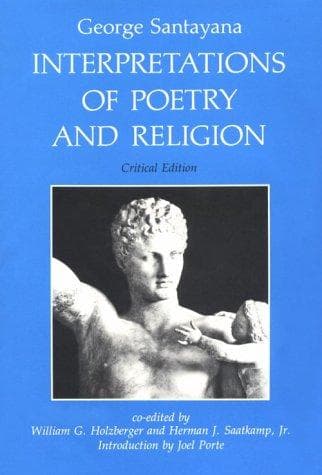
Interpretations of Poetry and ReligionSantayana, George
Religion
Interpretations of Poetry and Religion
Santayana, George
Aesthetics; Literature -- History and criticism; Poetry; Religion
Philo, in his commentaries on the Bible, sought to envelop and
transform every detail in the light of Platonic metaphysics. His
interpretations are often violent, but the ingenuous artifice of them
would have delighted his contemporaries as much as himself, and was
adopted afterward by all the Fathers and theologians of the Church.
Philo's theology was thus a success, even a model; yet he failed,
because of the inadequacy of his religion. What interest, what
relevance, could it have for any Gentile to hear about the deliverance
of Israel out of Egypt or out of Babylon, or about circumcision and
prescribed meats, or about the sacrifices in the Temple? What charm or
credibility could he find in further promises of glorious kingdoms,
flowing with milk and honey? Such images might later appeal to the
imagination of New England Puritans and make a religion for them: but
what meaning could they have to the weary Pagan? No doubt the Jews
carried with them an ideal of righteousness, and prosperity; but the
Gentile was sick of heroes and high priests and founders of cities.
Stoic virtues were as vain in his eyes as Sybaritic joys. He did not
wish his passions to be flattered, not even his pride or the passion
for a social Utopia. He wished his passions to be mortified and his
soul to be redeemed. He would not look for a Messiah, unless he could
find him on a cross.
That is the essence of the matter. What overcame the world, because
it was what the world desired, was not a moral reform--for that was
preached by every sect; not an ascetic regimen--for that was practised
by heathen gymnosophists and Pagan philosophers; not brotherly love
within the Church--for the Jews had and have that at least in equal
measure; but what overcame the world was what Saint Paul said he
would always preach: Christ and him crucified. Therein was a new
poetry, a new ideal, a new God. Therein was the transcript of the
real experience of humanity, as men found it in their inmost souls
and as they were dimly aware of it in universal history. The moving
power was a fable--for who stopped to question whether its elements
were historical, if only its meaning were profound and its inspiration
contagious? This fable had points of attachment to real life in a
visible brotherhood and in an extant worship, as well as in the
religious past of a whole people. At the same time it carried the
imagination into a new sphere; it sanctified the poverty and sorrow at
which Paganism had shuddered; it awakened tenderer emotions, revealed
more human objects of adoration, and furnished subtler instruments of
grace. It was a whole world of poetry descended among men, like the
angels at the Nativity, doubling, as it were, their habitation, so that
they might move through supernatural realms in the spirit while they
walked the earth in the flesh. The consciousness of new loves, new
duties, fresh consolations, and luminous unutterable hopes accompanied
them wherever they went.
Public-domain text, read in full here on John Shaqi.
Reviews
Reviews
No reviews yet
Be the first to share your thoughts on this work.
Elsewhere in the archive
Join the Discussion
Join the discussion
Sign in to leave a comment or review.
Sign InorCreate an account