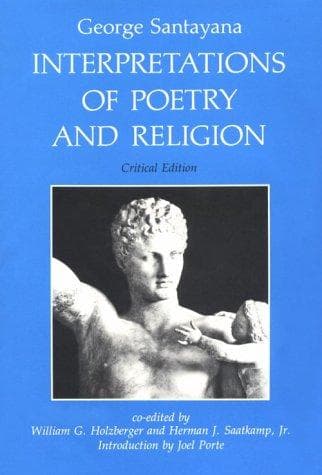
Interpretations of Poetry and ReligionSantayana, George
Religion
Interpretations of Poetry and Religion
Santayana, George
Aesthetics; Literature -- History and criticism; Poetry; Religion
The other circumstance that ennobled the Christian system was that
all its parts had some significance and poetic truth, although they
contained, or needed to contain, nothing empirically real. The system
was a great poem which, besides being well constructed in itself, was
allegorical of actual experience, and contained, as in a hieroglyph,
a very deep knowledge of the world and of the human mind. For what
was the object that unfolded itself before the Christian imagination,
the vision that converted and regenerated the world? It was a picture
of human destiny. It was an epic, containing, as it were, the moral
autobiography of man. The object of Pagan religion and philosophy had
been a picture of the material cosmos, conceived as a vast animal and
inhabited by a multitude of individual spirits. Even the Neo-Platonists
thought of nothing else, much as they might multiply abstract names for
its principles and fancifully confuse them with the spheres. It was
always a vast, living, physical engine, a cosmos of life in which man
had a determinate province. His spirit, losing its personality, might
be absorbed into the ethereal element from which it came; but this
emanation and absorption was itself an unchanging process, the systole
and diastole of the universal heart. Practical religion consisted in
honouring the nearest gods and accepting from them man's apportioned
goods, not without looking, perhaps, with a reverence that needed
no ritual, to the enveloping whole that prescribed to gods and men
their respective functions. Thus even Neo-Platonism represented man as
a minor incident in the universe, supernatural though that universe
might be. The spiritual spheres were only the invisible repetitions of
the visible, as the Platonic ideas from the beginning had been only a
dialectic reduplication of the objects in this world. It was against
this allotment that the soul was rebelling. It was looking for a
deliverance that should be not so much the consciousness of something
higher as the hope of something better.
Now, the great characteristic of Christianity, inherited from Judaism,
was that its scheme was historical. Not existences but events were the
subject of its primary interest. It presented a story, not a cosmology.
It was an epic in which there was, of course, superhuman machinery,
but of which the subject was man, and, notable circumstance, the Hero
was a man as well. Like Buddhism, it gave the highest honour to a
man who could lead his fellow-men to perfection. What had previously
been the divine reality--the engine of Nature--now became a temporary
stage, built for the exigencies of a human drama. What had been before
a detail of the edifice--the life of man--now became the argument and
purpose of the whole creation. Notable transformation, on which the
philosopher cannot meditate too much.
Public-domain text, read in full here on John Shaqi.
Reviews
Reviews
No reviews yet
Be the first to share your thoughts on this work.
Elsewhere in the archive
Join the Discussion
Join the discussion
Sign in to leave a comment or review.
Sign InorCreate an account