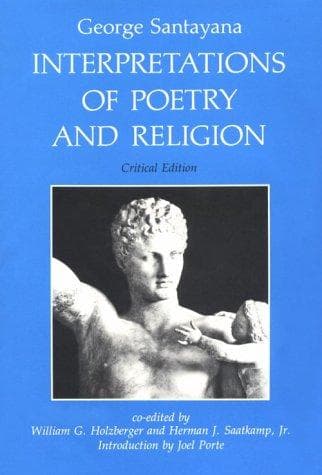
Interpretations of Poetry and ReligionSantayana, George
Religion
Interpretations of Poetry and Religion
Santayana, George
Aesthetics; Literature -- History and criticism; Poetry; Religion
So among the ancients it was not an abstract observation of Nature,
with conscious allegory supervening, that was the origin of mythology,
but the interpretation was spontaneous, the illusion was radical, a
consciousness of the god's presence was the first impression produced
by the phenomenon. Else, in this case too, poetry would never have
become superstition; what made it superstition was the initial
incapacity in people to discriminate the objects of imagination from
those of the understanding. The fancy thus attached its images, without
distinguishing their ideal locus, to the visible world, and men became
superstitious not because they had too much imagination, but because
they were not aware that they had any.
In what sense, then, are we justified in saying that religion expresses
moral ideals? In the sense that moral significance, while not the
source of religions, is the criterion of their value and the reason
why they may deserve to endure. Far as the conception of an allegory
may be from the minds of prophets, yet the prophecy can only take
root in the popular imagination if it recommends itself to some human
interest. There must be some correspondence between the doctrine
announced or the hopes set forth, and the natural demands of the
human spirit. Otherwise, although the new faith might be preached, it
would not be accepted. The significance of religious doctrines has
therefore been the condition of their spread, their maintenance, and
their development, although not the condition of their origin. In
Darwinian language, moral significance has been a spontaneous variation
of superstition, and this variation has insured its survival as a
religion. For religion differs from superstition not psychologically
but morally, not in its origin but in its worth. This worth, when
actually felt and appreciated, becomes of course a dynamic factor and
contributes like other psychological elements to the evolution of
events; but being a logical harmony, a rational beauty, this worth is
only appreciable by a few minds, and those the least primitive and the
least capable of guiding popular movements. Reason is powerless to
found religions, although it is alone competent to judge them. Good
religions are therefore the product of unconscious rationality, of
imaginative impulses fortunately moral.
Public-domain text, read in full here on John Shaqi.
Reviews
Reviews
No reviews yet
Be the first to share your thoughts on this work.
Elsewhere in the archive
Join the Discussion
Join the discussion
Sign in to leave a comment or review.
Sign InorCreate an account