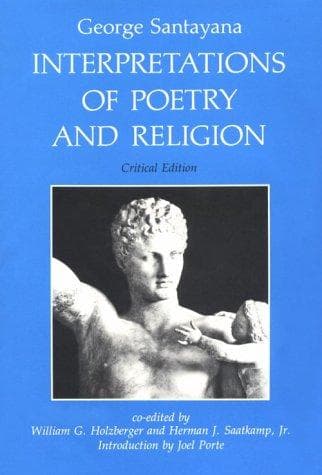
Interpretations of Poetry and ReligionSantayana, George
Religion
Interpretations of Poetry and Religion
Santayana, George
Aesthetics; Literature -- History and criticism; Poetry; Religion
Such is the nature of idealization. Like the Venus of Apelles, in
which all known beauties were combined, the ideal is the union of
all we prize in all creatures; and the mind that has once felt the
irresistible compulsion to create this ideal and to believe in it has
become incapable of unreserved love of anything else. The absolute
is a jealous god; it is a consuming fire that blasts the affections
upon which it feeds. For this reason the soul of Guido, in his sonnet,
is mortally wounded by the shaft of that beauty which has awakened a
vehement longing for perfection without being able to satisfy it. All
things become to the worshipper of the ideal so many signs and symbols
of what he seeks; like the votary who, kneeling now before one image
and now before another, lets his incense float by all with a certain
abstracted impartiality, because his aspiration mounts through them
equally to the invisible God they alike represent.
Another aspect of the same process is well described by Shakespeare, in
whom Italian influences count for much, when he says to the person he
has chosen as the object of his idealization:--
"Thy bosom is endeared with all hearts
Which I, by lacking, have supposed dead,
And there reigns love and all love's loving parts
And all those friends which I thought buried.
How many a holy and obsequious tear
Hath dear religious love stolen from mine eye
As interest for the dead, which now appear
But things removed, which hidden in thee lie.
Thou art the grave where buried love doth live
Hung with the trophies of my lovers gone,
Who all their parts of me to thee did give:
That due of many now is thine alone.
Their images I loved I view in thee,
And thou, all they, hast all the all of me."
We need not, then, waste erudition in trying to prove whether Dante's
Beatrice or Guido's Giovanna or any one else who has been the subject
of the greater poetry of love, was a symbol or a reality. To poets and
philosophers real things are themselves symbols. The child of seven
whom Dante saw at the Florentine feast was, if you will, a reality. As
such she is profoundly unimportant. To say that Dante loved her then
and ever after is another way of saying that she was a symbol to him.
That is the way with childish loves. Neither the conscious spell of the
senses nor the affinities of taste and character can then be powerful,
but the sense of loneliness and the vague need of loving may easily
conspire with the innocence of the eyes to fix upon a single image and
to make it the imaginary goal of all those instincts which as yet do
not know themselves.
Public-domain text, read in full here on John Shaqi.
Reviews
Reviews
No reviews yet
Be the first to share your thoughts on this work.
Elsewhere in the archive
Join the Discussion
Join the discussion
Sign in to leave a comment or review.
Sign InorCreate an account