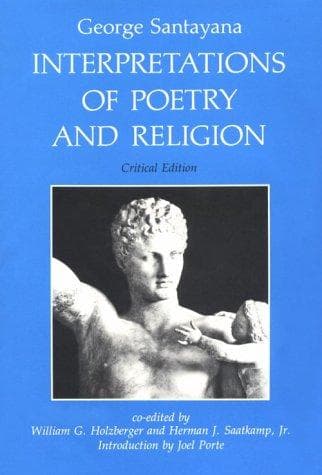
Interpretations of Poetry and ReligionSantayana, George
Religion
Interpretations of Poetry and Religion
Santayana, George
Aesthetics; Literature -- History and criticism; Poetry; Religion
"For faithful guide unto my labouring heart
Beauty was given me at birth,
To be my glass and lamp in either art.
Who thinketh otherwise misknows her worth,
For highest beauty only gives me light
To carve and paint aright.
Rash is the thought and vain
That maketh beauty from the senses grow.
She lifts to heaven hearts that truly know,
But eyes grown dim with pain
From mortal to immortal cannot go
Nor without grace of God look up again."
And here is a sonnet, called by Mr. Symonds "the heavenly birth of love
and beauty." I borrow in part from his translation:--
"My love's life comes not from this heart of mine.
The love wherewith I love thee hath no heart,
Turned thither whither no fell thoughts incline
And erring human passion leaves no smart.
Love, from God's bosom when our souls did part,
Made me pure eye to see, thee light to shine,
And I must needs, half mortal though thou art,
In spite of sorrow know thee all divine.
As heat in fire, so must eternity
In beauty dwell; through thee my soul's endeavour.
Mounts to the pattern and the source of thee;
And having found all heaven in thine eyes,
Beneath thy brows my burning spirit flies
There where I loved thee first to dwell for ever."
Something of this kind may also be found in the verses of Lorenzo de'
Medici, who, like Michael Angelo, was a poet only incidentally, and
even thought it necessary to apologize in a preface for having written
about love. Many of his compositions are, indeed, trivial enough, but
his pipings will not seem vain to the severest philosopher when he
finds them leading to strains like the following, where the thought
rises to the purest sphere of tragedy and of religion:--
"As a lamp, burning through the waning night,
When the oil begins to fail that fed its fire
Flares up, and in its dying waxes bright
And mounts and spreads, the better to expire;
So in this pilgrimage and earthly flight
The ancient hope is spent that fed desire,
And if there burn within a greater light
'Tis that the vigil's end approacheth nigher.
Hence thy last insult, Fortune, cannot move,
Nor death's inverted torches give alarm;
I see the end of wrath and bitter moan.
My fair Medusa into sculptured stone
Turns me no more, my Siren cannot charm.
Heaven draws me up to its supernal love."
Public-domain text, read in full here on John Shaqi.
Reviews
Reviews
No reviews yet
Be the first to share your thoughts on this work.
Elsewhere in the archive
Join the Discussion
Join the discussion
Sign in to leave a comment or review.
Sign InorCreate an account