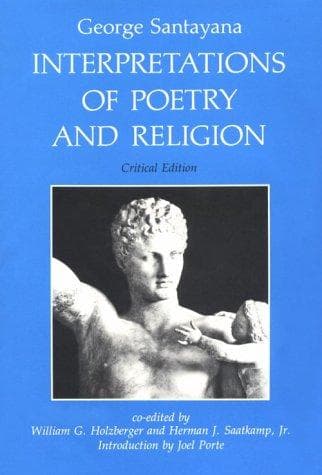
Interpretations of Poetry and ReligionSantayana, George
Religion
Interpretations of Poetry and Religion
Santayana, George
Aesthetics; Literature -- History and criticism; Poetry; Religion
As the senses that perceive, in the act of perceiving assert an
absolute reality in their object, as the mind that looks before and
after believes in the existence of a past and a future which cannot
now be experienced, so the imagination and the heart behold, when they
are left free to expand and express themselves, an absolute beauty
and a perfect love. Intense contemplation disentangles the ideal from
the idol of sense, and a purified will rests in it as in the true
object of worship. These are the oracles of reason, the prophecies of
those profounder spirits who in the world of Nature are obedient unto
death because they belong intrinsically to a world where death is
impossible, and who can rise continually, by abstraction from personal
sensibility, into identity with the eternal objects of rational life.
Such a religion must elude popular apprehension until it is translated
into myths and cosmological dogmas. It is easier for men to fill out
the life of the spirit by supplementing the facts of experience by
other facts for which there is no evidence than it is for them to
master the given facts and turn them to spiritual uses. Many can fight
for a doubtful fact when they cannot perform a difficult idealization.
They trust, as all men must, to what they can see; they believe in
things as their faculties represent things to them. By the same right,
however, the rationalizer of experience believes in his visions; he
rests, like the meanest of us, in the present object of his thought.
So long as we live at all we must trust in something, at least in the
coherence and permanence of the visible world and in the value of the
objects of our own desires. And if we live nobly, we are under the same
necessity of believing in noble things. However unreal, therefore,
these Platonic intuitions may seem to those of us whose interests lie
in other quarters, we may rest assured that these very thoughts would
dominate our minds and these eternal companionships would cheer our
desolation, if we had wrestled as manfully with the same passions and
passed through the transmuting fire of as great a love.
VI
THE ABSENCE OF RELIGION IN SHAKESPEARE
Public-domain text, read in full here on John Shaqi.
Reviews
Reviews
No reviews yet
Be the first to share your thoughts on this work.
Elsewhere in the archive
Join the Discussion
Join the discussion
Sign in to leave a comment or review.
Sign InorCreate an account