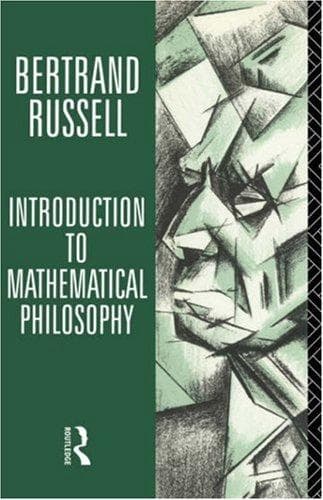
Introduction to Mathematical PhilosophyRussell, Bertrand
Philosophy
Introduction to Mathematical Philosophy
Russell, Bertrand
Mathematics -- Philosophy
If we were concerned to examine fully the relation of idea and
object, we should have to enter upon a number of psychological
and logical inquiries, which are not relevant to our main purpose.
But a few further points should be noted. If "idea" is to be
understood logically, it may be identical with the object, or it
may stand for a description (in the sense to be explained in a
subsequent chapter). In the former case the argument fails,
because it was essential to the proof of reflexiveness that object
and idea should be distinct. In the second case the argument
also fails, because the relation of object and description is not
[Pg 139]
one-one: there are innumerable correct descriptions of any given
object. Socrates (e.g.) may be described as "the master of
Plato," or as "the philosopher who drank the hemlock," or as
"the husband of Xantippe." If—to take up the remaining
hypothesis—"idea" is to be interpreted psychologically, it must
be maintained that there is not any one definite psychological
entity which could be called the idea of the object: there are innumerable
beliefs and attitudes, each of which could be called an
idea of the object in the sense in which we might say "my idea
of Socrates is quite different from yours," but there is not any
central entity (except Socrates himself) to bind together various
"ideas of Socrates," and thus there is not any such one-one relation
of idea and object as the argument supposes. Nor, of course,
as we have already noted, is it true psychologically that there are
ideas (in however extended a sense) of more than a tiny proportion
of the things in the world. For all these reasons, the above
argument in favour of the logical existence of reflexive classes
must be rejected.
Public-domain text, read in full here on John Shaqi.
Reviews
Reviews
No reviews yet
Be the first to share your thoughts on this work.
Elsewhere in the archive
Join the Discussion
Join the discussion
Sign in to leave a comment or review.
Sign InorCreate an account