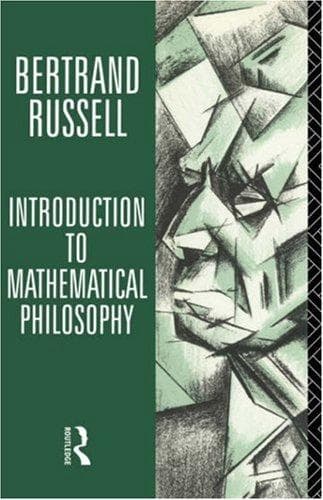
Introduction to Mathematical PhilosophyRussell, Bertrand
Philosophy
Introduction to Mathematical Philosophy
Russell, Bertrand
Mathematics -- Philosophy
These are the formal principles of deduction employed in
Principia Mathematica. A formal principle of deduction has a
double use, and it is in order to make this clear that we have
cited the above five propositions. It has a use as the premiss
of an inference, and a use as establishing the fact that the premiss
implies the conclusion. In the schema of an inference
we have a proposition , and a proposition " implies ," from
which we infer . Now when we are concerned with the principles
of deduction, our apparatus of primitive propositions has
to yield both the and the " implies " of our inferences.
That is to say, our rules of deduction are to be used, not only as
rules, which is their use for establishing " implies " but also
as substantive premisses, i.e. as the of our schema. Suppose,
for example, we wish to prove that if implies , then if implies
it follows that implies . We have here a relation of
three propositions which state implications. Put
implies ,
implies , and
implies .
Then we have to prove that implies that implies . Now
take the fifth of our above principles, substitute not- for ,
and remember that "not- or " is by definition the same as
" implies ." Thus our fifth principle yields:
"If implies , then ' implies ' implies 'implies ,'"
i.e. "implies that implies ." Call this
proposition .
But the fourth of our principles, when we substitute not-,
not-, for and , and remember the definition of implication,
becomes:
"If implies that implies , then implies
that implies ."
Writing in place of , in place of , and
in place of , this
becomes:
"If implies that implies , then
implies that implies ."
Call this .
[Pg 150]
Now we proved by means of our fifth principle that
" implies that implies ," which was
what we called .
Thus we have here an instance of the schema of inference,
since represents the of our scheme, and represents the
" implies ." Hence we arrive at , namely,
" implies that implies ,"
which was the proposition to be proved. In this proof, the
adaptation of our fifth principle, which yields , occurs as a
substantive premiss; while the adaptation of our fourth principle,
which yields , is used to give the form of the inference. The
formal and material employments of premisses in the theory
of deduction are closely intertwined, and it is not very important
to keep them separated, provided we realise that they are in
theory distinct.
Public-domain text, read in full here on John Shaqi.
Reviews
Reviews
No reviews yet
Be the first to share your thoughts on this work.
Elsewhere in the archive
Join the Discussion
Join the discussion
Sign in to leave a comment or review.
Sign InorCreate an account