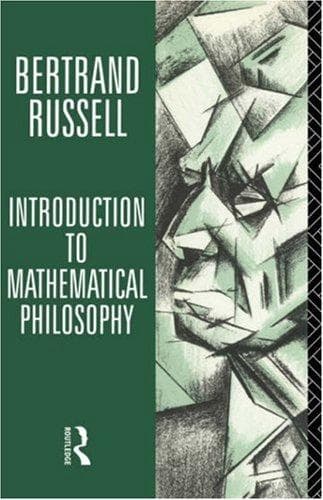
Introduction to Mathematical PhilosophyRussell, Bertrand
Philosophy
Introduction to Mathematical Philosophy
Russell, Bertrand
Mathematics -- Philosophy
There is? if I am not mistaken, a certain confusion in the
[Pg 152]
minds of some authors as to the relation, between propositions,
in virtue of which an inference is valid. In order that it may
be valid to infer from , it is only necessary that should be
true and that the proposition "not- or " should be true.
Whenever this is the case, it is clear that must be true. But
inference will only in fact take place when the proposition "not-
or " is known otherwise than through knowledge of not- or
knowledge of . Whenever is false, "not- or " is true,
but is useless for inference, which requires that should be true.
Whenever is already known to be true, "not- or " is of
course also known to be true, but is again useless for inference,
since is already known, and therefore does not need to be
inferred. In fact, inference only arises when "not- or "
can be known without our knowing already which of the two
alternatives it is that makes the disjunction true. Now, the
circumstances under which this occurs are those in which certain
relations of form exist between and . For example, we know
that if implies the negation of , then implies the negation
of . Between " implies not-" and " implies not-" there
is a formal relation which enables us to know that the first implies
the second, without having first to know that the first is false
or to know that the second is true. It is under such circumstances
that the relation of implication is practically useful for
drawing inferences.
Public-domain text, read in full here on John Shaqi.
Reviews
Reviews
No reviews yet
Be the first to share your thoughts on this work.
Elsewhere in the archive
Join the Discussion
Join the discussion
Sign in to leave a comment or review.
Sign InorCreate an account