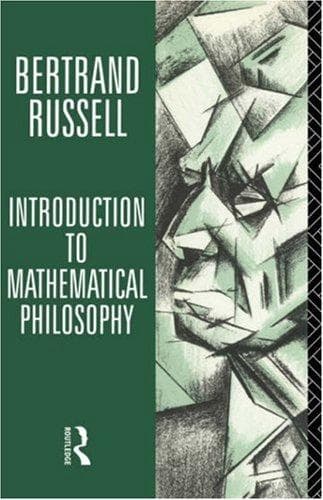
Introduction to Mathematical PhilosophyRussell, Bertrand
Philosophy
Introduction to Mathematical Philosophy
Russell, Bertrand
Mathematics -- Philosophy
Now it is easy to see that this number is not one of the inductive
numbers. If is any inductive number, the number of numbers
from 0 to (both included) is ; therefore the total number
of inductive numbers is greater than , no matter which of the
inductive numbers may be. If we arrange the inductive
numbers in a series in order of magnitude, this series has no last
term; but if is an inductive number, every series whose field
has terms has a last term, as it is easy to prove. Such differences
might be multiplied ad lib. Thus the number of inductive
numbers is a new number, different from all of them, not possessing
all inductive properties. It may happen that 0 has a certain
[Pg 78]
property, and that if has it so has , and yet that this new
number does not have it. The difficulties that so long delayed
the theory of infinite numbers were largely due to the fact that
some, at least, of the inductive properties were wrongly judged
to be such as must belong to all numbers; indeed it was thought
that they could not be denied without contradiction. The first
step in understanding infinite numbers consists in realising the
mistakenness of this view.
The most noteworthy and astonishing difference between an
inductive number and this new number is that this new number
is unchanged by adding 1 or subtracting 1 or doubling or halving
or any of a number of other operations which we think of as
necessarily making a number larger or smaller. The fact of being
not altered by the addition of 1 is used by Cantor for the definition
of what he calls "transfinite" cardinal numbers; but for
various reasons, some of which will appear as we proceed, it is
better to define an infinite cardinal number as one which does
not possess all inductive properties, i.e. simply as one which is
not an inductive number. Nevertheless, the property of being
unchanged by the addition of 1 is a very important one, and we
must dwell on it for a time.
Public-domain text, read in full here on John Shaqi.
Reviews
Reviews
No reviews yet
Be the first to share your thoughts on this work.
Join the Discussion
Join the discussion
Sign in to leave a comment or review.
Sign InorCreate an account