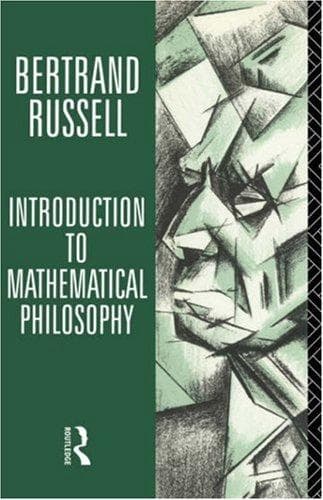
Introduction to Mathematical PhilosophyRussell, Bertrand
Philosophy
Introduction to Mathematical Philosophy
Russell, Bertrand
Mathematics -- Philosophy
On the other hand, the series of ordinals—and indeed every well-ordered
series—has no lower limiting-points, because there are
no terms except the last that have no immediate successors. But
if we consider such a series as the series of ratios, every member
of this series is both an upper and a lower limiting-point for
suitably chosen sets. If we consider the series of real numbers,
and select out of it the rational real numbers, this set (the
rationals) will have all the real numbers as upper and lower
limiting-points. The limiting-points of a set are called its "first
derivative," and the limiting-points of the first derivative are
called the second derivative, and so on.
With regard to limits, we may distinguish various grades of
what may be called "continuity" in a series. The word "continuity"
had been used for a long time, but had remained without
any precise definition until the time of Dedekind and Cantor.
Each of these two men gave a precise significance to the term,
but Cantor's definition is narrower than Dedekind's: a series
which has Cantorian continuity must have Dedekindian continuity,
but the converse does not hold.
The first definition that would naturally occur to a man seeking
a precise meaning for the continuity of series would be to define
it as consisting in what we have called "compactness," i.e. in the
fact that between any two terms of the series there are others.
But this would be an inadequate definition, because of the
existence of "gaps" in series such as the series of ratios. We
saw in Chapter VII. that there are innumerable ways in which
the series of ratios can be divided into two parts, of which one
wholly precedes the other, and of which the first has no last term,
[Pg 100]
while the second has no first term. Such a state of affairs seems
contrary to the vague feeling we have as to what should characterise
"continuity," and, what is more, it shows that the series of
ratios is not the sort of series that is needed for many mathematical
purposes. Take geometry, for example: we wish to be able to
say that when two straight lines cross each other they have a
point in common, but if the series of points on a line were similar
to the series of ratios, the two lines might cross in a "gap" and
have no point in common. This is a crude example, but many
others might be given to show that compactness is inadequate as
a mathematical definition of continuity.
Public-domain text, read in full here on John Shaqi.
Reviews
Reviews
No reviews yet
Be the first to share your thoughts on this work.
Elsewhere in the archive
Join the Discussion
Join the discussion
Sign in to leave a comment or review.
Sign InorCreate an account