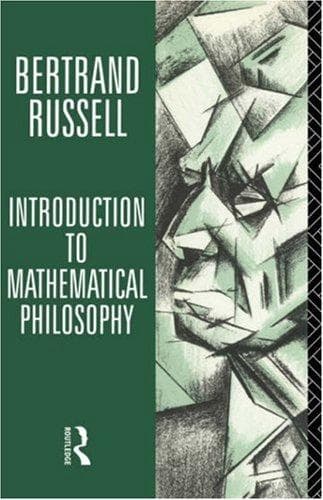
Introduction to Mathematical PhilosophyRussell, Bertrand
Philosophy
Introduction to Mathematical Philosophy
Russell, Bertrand
Mathematics -- Philosophy
The second condition is obtained by replacing by its
converse; the third and fourth are obtained from the first and
second by replacing by its converse.
There is thus nothing, in the notions of the limit of a function
or the continuity of a function, that essentially involves number.
Both can be defined generally, and many propositions about
them can be proved for any two series (one being the argument-series
and the other the value-series). It will be seen that the
definitions do not involve infinitesimals. They involve infinite
classes of intervals, growing smaller without any limit short of
zero, but they do not involve any intervals that are not finite.
This is analogous to the fact that if a line an inch long be halved,
then halved again, and so on indefinitely, we never reach infinitesimals
in this way: after bisections, the length of our bit is
of an inch; and this is finite whatever finite number may
be. The process of successive bisection does not lead to
divisions whose ordinal number is infinite, since it is essentially
a one-by-one process. Thus infinitesimals are not to be reached
in this way. Confusions on such topics have had much to do
with the difficulties which have been found in the discussion of
infinity and continuity.
[Pg 116]
CHAPTER XII
SELECTIONS AND THE MULTIPLICATIVE AXIOM
IN this chapter we have to consider an axiom which can be
enunciated, but not proved, in terms of logic, and which is convenient,
though not indispensable, in certain portions of mathematics.
It is convenient, in the sense that many interesting
propositions, which it seems natural to suppose true, cannot
be proved without its help; but it is not indispensable, because
even without those propositions the subjects in which they
occur still exist, though in a somewhat mutilated form.
Before enunciating the multiplicative axiom, we must first
explain the theory of selections, and the definition of multiplication
when the number of factors may be infinite.
Public-domain text, read in full here on John Shaqi.
Reviews
Reviews
No reviews yet
Be the first to share your thoughts on this work.
Elsewhere in the archive
Join the Discussion
Join the discussion
Sign in to leave a comment or review.
Sign InorCreate an account