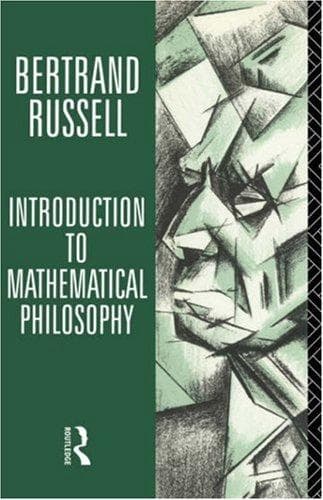
Introduction to Mathematical PhilosophyRussell, Bertrand
Philosophy
Introduction to Mathematical Philosophy
Russell, Bertrand
Mathematics -- Philosophy
This fact has various curious consequences. To begin with,
we know that . It is commonly inferred from
this that the sum of classes each having members must
itself have members, but this inference is fallacious, since we
do not know that the number of terms in such a sum is ,
nor consequently that it is . This has a bearing upon the theory
of transfinite ordinals. It is easy to prove that an ordinal which
has predecessors must be one of what Cantor calls the "second
class," i.e. such that a series having this ordinal number will have
terms in its field. It is also easy to see that, if we take any
progression of ordinals of the second class, the predecessors of
their limit form at most the sum of classes each having terms.
It is inferred thence—fallaciously, unless the multiplicative
axiom is true—that the predecessors of the limit are in
number, and therefore that the limit is a number of the "second
class." That is to say, it is supposed to be proved that any progression
of ordinals of the second class has a limit which is again
an ordinal of the second class. This proposition, with the corollary
that (the smallest ordinal of the third class) is not the
limit of any progression, is involved in most of the recognised
theory of ordinals of the second class. In view of the way in
which the multiplicative axiom is involved, the proposition and
its corollary cannot be regarded as proved. They may be true,
or they may not. All that can be said at present is that we do
not know. Thus the greater part of the theory of ordinals of
the second class must be regarded as unproved.
Public-domain text, read in full here on John Shaqi.
Reviews
Reviews
No reviews yet
Be the first to share your thoughts on this work.
Elsewhere in the archive
Join the Discussion
Join the discussion
Sign in to leave a comment or review.
Sign InorCreate an account